
Search "buccal fat removal before and after" and nearly every result stops at the six-week mark — a slimmer jawline, a more sculpted, "snatched" mid-face, captioned as the finished story. It isn't. Because this procedure permanently removes a defined fat compartment from the cheek, the more important question is what that face looks like in 10 years, after natural volume loss has had time to layer on top of a change that can't be undone. This guide covers both halves of that story honestly.
What Changes Immediately
Buccal fat removal targets the buccal fat pad, a distinct, encapsulated pocket of fat that sits deep in the cheek between the facial muscles.1 Removing part of it reduces fullness in the lower and mid-cheek, producing a more contoured, angular look often described as "snatched" — visible cheekbones and a narrower lower face. The change is most noticeable in patients who started with a naturally rounder, fuller face; it's far more subtle in patients who were already lean.
From an anatomical perspective, the buccal fat pad has a complex three-lobe structure with ligament attachments and extensions into multiple facial spaces — only the central body and anterior extension are typically accessible and appropriate for reduction through the standard intraoral approach. The total volume of the pad varies considerably between individuals, which is one reason the visible change can look dramatically different from one patient to the next even with the same surgical approach. A surgeon who preserves the deeper, temporal extension of the pad (rather than attempting to remove everything accessible) reduces the risk of inadvertent damage to nearby facial nerve branches.
Why Early Photos Overstate the Change
Surgical trauma to the cheek causes swelling that can last for several weeks, and many social-media "results" are filmed or photographed well before that swelling has resolved. A face photographed at day 10 may look dramatically slimmer simply because of bruising and inflammation patterns, not because the true contour has settled. The genuinely final result — once residual swelling is gone and tissue has re-draped over the new contour — usually isn't visible until 3 to 6 months after surgery, and it is typically less extreme than the early "after" photo suggested.
Is It Permanent?
Yes. Once the buccal fat pad is surgically removed, that specific tissue does not grow back. This is a meaningful difference from procedures like liposuction on other body areas where some fat cells can still expand with future weight gain. Significant weight gain afterward can still add fat elsewhere in the face and jaw, giving a fuller overall appearance that partially masks the change — but it will not restore volume specifically in the space where the buccal fat pad used to sit. This permanence is precisely why surgeons emphasize a conservative, staged approach: it's straightforward to remove more tissue in a follow-up procedure, but impossible to put it back.
How It Ages: The 10-Year Question
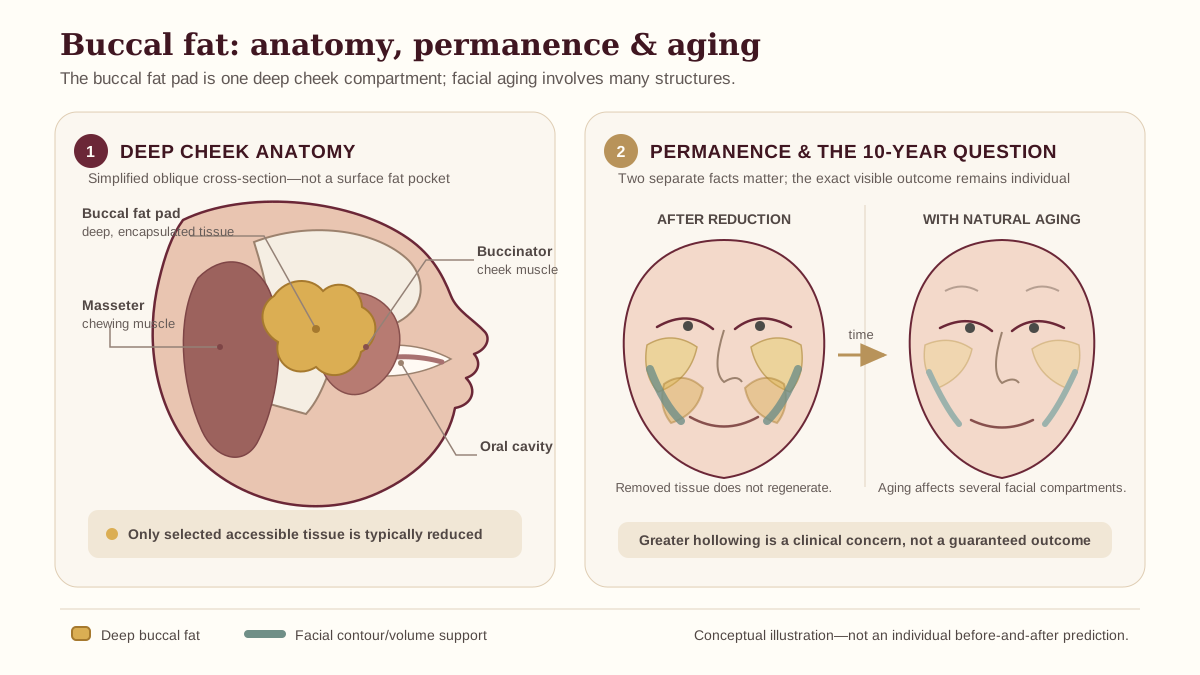
Natural Facial Volume Loss With Age
Independent of any surgery, the face loses fat volume gradually with age, and research using 3D imaging has documented that different facial fat compartments — including the buccal region — show distinct patterns of age-related change over time.3 In a face that still has its buccal fat pad, this natural thinning is buffered somewhat by the remaining tissue. In a face where the pad has already been surgically removed, that buffer is gone, meaning the visible effects of age-related volume loss may appear more pronounced sooner.
Why Some Surgeons Advise Caution in Younger, Thinner Patients
Because buccal fat pad reduction is irreversible and facial fat naturally redistributes through the twenties, many surgeons decline to perform the procedure on patients who are very young, already thin-faced, or who have limited skeletal support in the cheekbones.2 Removing fat from a face that hasn't finished its natural maturation — or one with little underlying structure to sustain the mid-face — raises the risk of a hollow, gaunt, or prematurely aged look years down the road.
What the Evidence Actually Shows vs What's Speculation
To be direct about the limits of current research: long-term studies following buccal fat removal patients for a decade or more are limited. What the evidence does support is the anatomical permanence of the fat pad removal and the general pattern of age-related facial volume loss.1 What remains more speculative — repeated in social media commentary but not rigorously studied — is exactly how much more dramatically an individual face will hollow compared to if the fat pad had been left in place. Both patients and surgeons should treat that specific claim as a reasonable clinical concern, not a proven statistic.
Who Tends to Age Well After It
Patients with strong underlying bone structure, good skin elasticity, and a face that was notably full before surgery tend to be the best long-term candidates, since they have more structural support to carry a mid-face with less fat volume. Conversely, patients with thin skin, minimal cheekbone projection, or a face that was already lean before the procedure are more likely to see a hollow appearance emerge as natural aging progresses. This is a major reason candidacy evaluation should look at bone structure and fat distribution together, not simply "do you want a slimmer face."
If You Regret It: Options
If a patient later feels their face is too gaunt, the removed buccal fat pad itself cannot be replaced, but volume can be added back into the region using fat transfer harvested from elsewhere in the body, or with dermal filler. Neither approach recreates the exact original anatomy, and results are more of a volumizing correction than a true reversal. This is worth discussing candidly during the initial consultation, before the original procedure, rather than after.
Alternatives to Consider First
Because this change is permanent, it's reasonable to explore non-surgical options first if you're uncertain, including temporary dermal filler elsewhere in the face to see how a change in facial proportion feels, or simply allowing more time to see how your face's fat distribution settles into your late twenties. A board-certified surgeon should be willing to discuss these lower-commitment options rather than moving straight to permanent surgery.
It is also important to confirm that the fullness you dislike actually comes from the buccal compartment. Jaw-muscle width, superficial cheek fat, bone structure, and fullness below the chin can create a similar impression but will not be corrected by removing the buccal pad. Standardized photographs from the front and both profiles, taken without contouring makeup or wide-angle distortion, can make that distinction easier to discuss during consultation.
Frequently Asked Questions
Is buccal fat removal permanent?
Yes. The buccal fat pad does not regenerate once it is surgically removed, so the volume reduction in the mid-cheek area is considered permanent. This is different from non-surgical fat-reduction methods, and it's the main reason surgeons recommend a conservative amount be taken during the initial buccal fat removal procedure.
Will buccal fat removal make me look older later?
It can contribute to a hollower, more angular look as you lose additional facial volume naturally with age, since you'll have less buccal fat available to soften that process. This risk is why candidacy and timing matter — see our section on how faces age after the procedure above.
Can buccal fat come back with weight gain?
The removed fat pad itself will not return, but significant weight gain can still add fat to other areas of the face and jawline, partially masking the change. It won't restore volume specifically in the buccal space that was removed.
Can buccal fat removal be reversed?
Not in the sense of restoring the original fat pad, since that tissue is gone. If someone regrets the result, fat transfer or dermal filler can add volume back to the area, though it won't precisely recreate the original anatomy.
What age is too young for buccal fat removal?
Most surgeons are cautious about performing this procedure on patients in their late teens or early twenties, because facial fat naturally continues to redistribute into the mid-to-late twenties. Removing fat before that process finishes raises the risk of a gaunt appearance emerging years later.
How do I know if I'm a good candidate for buccal fat removal?
Good candidates typically have a fuller, rounder mid-face, adequate skeletal support and skin elasticity, and stable body weight, with realistic expectations about a permanent, moderate change. A consultation with a board-certified surgeon — see our guide to verifying credentials — who evaluates your bone structure and fat distribution is the only reliable way to confirm candidacy.