Rhinoplasty consistently ranks among the most requested — and most technically demanding — procedures in facial plastic surgery, because the nose sits at the center of the face and even small changes are highly visible. ASPS data lists rhinoplasty among the top cosmetic facial procedures performed in the US each year.2 This guide covers technique choice, the functional-breathing question, ethnic and preservation approaches, and the risks of the non-surgical filler version popular on social media.
What Rhinoplasty Can and Can't Change
Surgical rhinoplasty can reduce or reshape a dorsal hump, refine a bulbous or drooping tip, narrow overly wide nostrils, straighten a crooked nose, and correct structural breathing problems like a deviated septum. It generally cannot dramatically change skin thickness (thick-skinned noses show less tip definition regardless of cartilage work) and cannot fully correct severe trauma-related asymmetry without more extensive reconstruction. A realistic consultation discusses your specific skin type and bone/cartilage structure, not just generic "after" photos from other patients.
Cosmetic vs Functional
Rhinoplasty performed purely to change appearance is classified as cosmetic and is not insurance-eligible. When surgery also corrects a structural breathing problem — most commonly a deviated septum — that functional portion (often billed as a septoplasty) may be covered, while cosmetic reshaping stays out-of-pocket. A combined septorhinoplasty addresses both at once.
Am I a Candidate?
Good candidates are healthy non-smokers with fully developed facial growth — typically mid-teens or older — and realistic expectations about what their anatomy can actually achieve. Active smokers are usually asked to stop for several weeks around surgery, since nicotine impairs healing. Uncontrolled bleeding disorders, autoimmune conditions, or multiple prior nasal surgeries need individualized assessment. A thorough consultation includes an internal nasal exam, not just external photos — deviated septum, internal valve collapse, and turbinate enlargement all affect breathing. Patients pursuing rhinoplasty mainly for breathing should document functional symptoms (exercise difficulty, nighttime mouth breathing, recurrent sinus pressure) in case insurance coverage is pursued for that portion.
Open vs Closed Technique
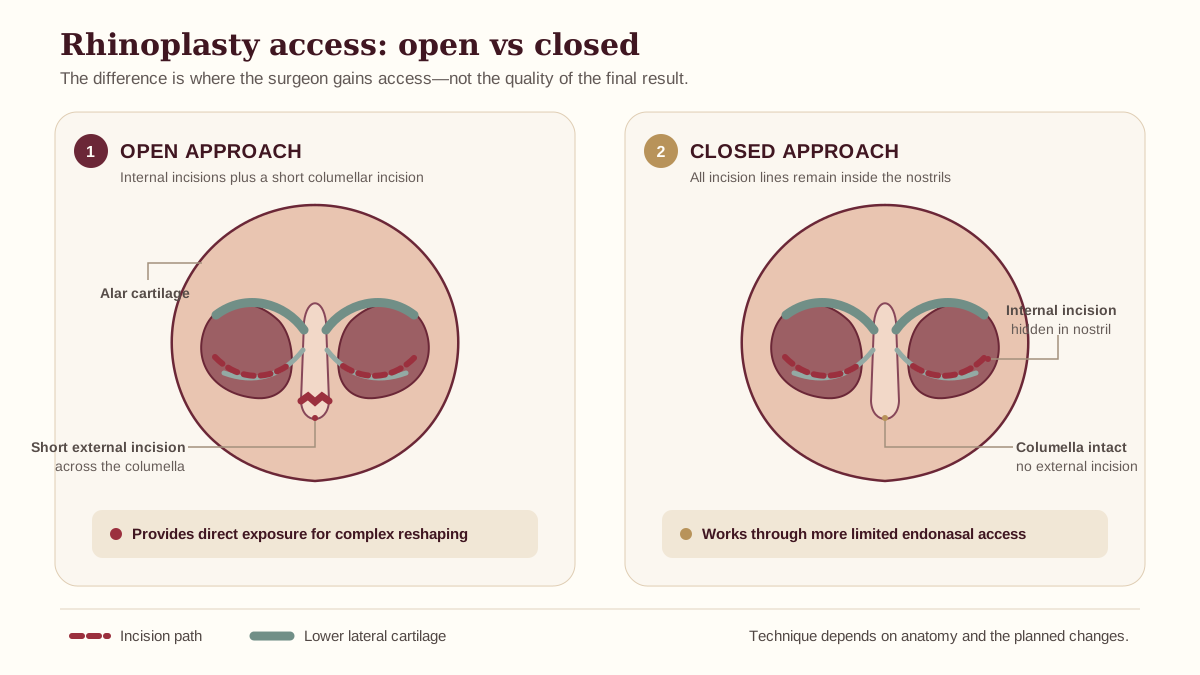
| Factor | Open Rhinoplasty | Closed Rhinoplasty |
|---|---|---|
| Incision | Small incision across the columella + inside nostrils | Entirely inside the nostrils |
| Visibility for surgeon | Full direct view of cartilage/bone structure | Limited, works through nostril access |
| Best suited for | Complex reshaping, tip work, revision cases | More limited, straightforward changes |
| External scar | Small, usually well-camouflaged over time | None |
| Typical swelling | Slightly more, slightly longer to resolve | Often marginally less |
The Procedure & Anesthesia
Most rhinoplasty is performed under general anesthesia in an accredited outpatient facility; total operating time runs 1.5 to 3 hours. The skin envelope is elevated from underlying cartilage and bone, the dorsum and tip are reshaped (sometimes with bone rasping), a deviated septum is corrected if present, and structural grafts — usually harvested from the septum itself, or ear/rib cartilage in revision cases — are placed where needed before the skin is redraped and an external splint applied.
Ethnic & Preservation Rhinoplasty
Modern rhinoplasty has moved away from a single Western-normative ideal nose shape toward techniques that work with a patient's existing ethnic and facial features rather than erasing them — conservative nostril narrowing, tip grafts instead of aggressive resection, and careful thick-skin management, aimed at a natural result that still looks like the patient's own face. Preservation rhinoplasty keeps more of the nose's original supporting ligament and cartilage intact, especially when lowering a dorsal hump where traditional reduction can leave a visible step-off. See our guide on ethnic rhinoplasty for more.
Liquid / Non-Surgical Rhinoplasty — What It Does & Its Risks
Liquid rhinoplasty uses injectable dermal filler to camouflage a small dorsal hump or improve tip projection temporarily, with no incision or downtime beyond mild swelling. It cannot reduce the size of a nose — filler only adds volume. The risk profile deserves direct, unsoftened attention: a systematic review and meta-analysis of nonsurgical rhinoplasty found an overall complication rate of 2.52% across cohort studies, including 30 documented episodes of vessel occlusion (0.35%) and 8 documented episodes of vision loss (0.09%).1 Occlusion happens when filler is inadvertently injected into or compresses a blood vessel, which can cause skin tissue death or, in the most serious cases, travel to vessels supplying the eye and cause permanent vision loss.
The nose is not a low-risk filler site — a separate review of ocular complications from soft-tissue fillers found that nasal injection accounted for roughly 35% of recent filler-related vision-loss cases.3 Liquid rhinoplasty should only be performed by an injector trained specifically in facial vascular anatomy, with an emergency hyaluronidase protocol in place. See our liquid rhinoplasty guide for the full risk picture.
Revision Rhinoplasty: When & Why
Revision rhinoplasty addresses a prior surgery that didn't achieve the intended result — common reasons include persistent breathing difficulty, asymmetry, an overly pinched tip, or a visible bridge irregularity. Surgeons generally recommend waiting at least a full year, since scar remodeling keeps changing the nose's shape well past the first few months. Revision is technically harder than a first surgery, since scar tissue and previously grafted cartilage complicate the anatomy. See our pages on revision surgery and revision rhinoplasty for more.
Risks & Complications
Rhinoplasty carries the standard surgical risks of infection, bleeding, anesthesia reaction, and a result that doesn't meet expectations — sometimes requiring revision after full healing. Procedure-specific complications include worsened breathing from inadequate internal valve support, visible asymmetry, contour irregularities like a pollybeak deformity, and tip numbness that usually resolves gradually. Over-resection of cartilage — particularly in older reduction-focused techniques — remains a documented cause of long-term structural weakness and tip collapse. See our full risks and complications guide and our credential verification guide before booking.
Recovery Timeline
Most patients return to non-strenuous work within 1 to 2 weeks. The genuinely important thing to understand is that rhinoplasty swelling, particularly at the tip, can take up to 12 months to fully resolve — this is normal, not a sign of a poor result, and it's why experienced surgeons discourage judging the final outcome before a year has passed.
Days 1–3: Congestion and limited nasal breathing if packing is in place; pain is typically moderate, managed with oral medication. Head elevation and cold compresses around (not on) the eyes limit bruising.
Days 4–14: External splint comes off around day 7; periorbital bruising fades though the nose itself stays swollen. Strenuous activity and contact sports stay off limits, and glasses may need temporary taping to keep weight off the healing bridge.
Months 1–12: Bridge swelling subsides faster than tip swelling, which keeps refining for many months — comparing your result to someone else's early post-op photos is misleading. See our full rhinoplasty recovery timeline for the week-by-week breakdown.
Cost
Average US cost for rhinoplasty typically runs $8,000 to $15,000, reflecting its technical complexity; revision cases cost more due to added surgical difficulty. When a functional septal component is documented, that portion may be billed separately to insurance while the cosmetic component stays out-of-pocket. See our full rhinoplasty cost guide for an itemized breakdown.
Frequently Asked Questions
What's the difference between open and closed rhinoplasty?
Open rhinoplasty uses a small incision across the columella, giving the surgeon full visibility for complex reshaping, while closed rhinoplasty keeps all incisions inside the nostrils with no external scar, typically used for more limited changes. The choice depends on the complexity needed, not just surgeon preference.
Is liquid rhinoplasty safe?
Liquid rhinoplasty carries a real, well-documented risk of vascular occlusion — filler blocking a blood vessel — which can cause skin necrosis or, rarely, vision loss. A large meta-analysis found occlusion in roughly 0.35% of cases and vision loss in about 0.09%, low overall but serious enough that only an experienced, trained injector should perform it, with an emergency protocol in place. See our liquid rhinoplasty guide for the full risk picture.
What is preservation rhinoplasty?
Preservation rhinoplasty keeps more of the nose's original supporting cartilage and ligament intact, reshaping the bridge by repositioning existing tissue rather than removing the dorsal hump entirely and rebuilding it — this can produce a more naturally contoured result for suitable candidates.
When is revision rhinoplasty needed?
Revision surgery is considered when the initial result doesn't meet functional or aesthetic goals after full healing — typically not evaluated until at least a year, since swelling and scar tissue keep changing the nose's shape for many months. See our revision rhinoplasty guide for more.
How long is rhinoplasty recovery?
Most bruising and swelling resolve within 2 weeks, and the external splint comes off around day 7. Tip swelling can take 12 months to fully resolve — see our full recovery timeline for the complete picture.
How much does rhinoplasty cost?
Average US cost runs $8,000 to $15,000 depending on complexity and geography. See our dedicated rhinoplasty cost guide for a full breakdown.