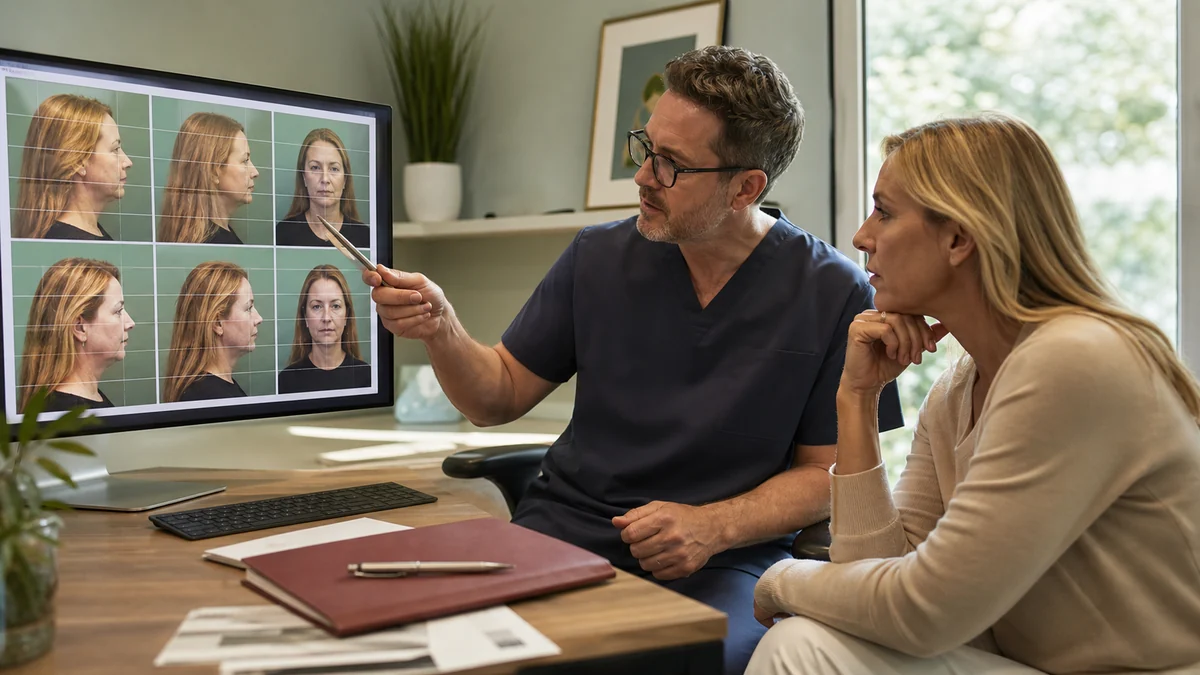
Before-and-after galleries are one of the most persuasive tools in cosmetic surgery marketing, and one of the easiest to misread. This page focuses on the general, cross-procedure skill of evaluating any gallery critically — for a fully worked example applying this exact framework to one specific surgery, see our BBL before-and-after guide.
Pose, Lighting & Timing
Check whether camera angle, distance, and lighting are consistent between the "before" and "after" images — even small differences in these variables can make a modest result look far more dramatic than it actually was. Also check the patient's posture and muscle tension in each photo, since a deliberately relaxed "after" pose compared with a tense "before" pose can exaggerate an apparent change. Finally, ask how much time elapsed between the photographs: an unlabeled early postoperative image is not equivalent to a mature result.
Background and framing matter too. A slightly closer camera distance in the "after" photo can make a treated area look proportionally larger or smaller relative to the rest of the body, and a different background color or contrast can shift how a scar, skin tone, or contour reads to the eye. None of these techniques are necessarily used with intent to deceive — sometimes they're simply the byproduct of photos taken months apart, by different staff, in a different room — but the effect on your perception is the same regardless of intent, which is exactly why a structured, skeptical read matters.
Procedure-specific swelling curves add another layer. Rhinoplasty tip refinement, breast implant drop-and-fluff, and body-contouring edema all follow different timelines — an "after" photo at six weeks may show change that continues to evolve for months. When a gallery cannot specify capture dates, ask during consultation rather than inferring from the image alone. The same photo-reading skill applies whether images come from a domestic practice website, a social media account, or an overseas coordinator's portfolio.
If a practice offers only patient testimonials without dated clinical photos, treat testimonials as marketing narrative — useful for tone, not for outcome prediction. The critical-reading framework on this page applies wherever a result is presented visually; written praise without verifiable images deserves the same skepticism as a dramatic gallery with inconsistent lighting.
Editing Awareness
Photo editing doesn't have to be dramatic to be misleading — even a shift in exposure, white balance, or minor retouching applied differently to the two images can meaningfully change how a result appears side by side. This is a real, if often overlooked, source of exaggeration in surgical marketing photos, and it's worth keeping in mind that a gallery's presentation is a marketing choice, not a clinical document. If a gallery is available only as a set of curated, professionally shot images rather than more casual clinical photography, that alone is a reason to ask more, not fewer, questions about how representative it actually is.
Volume-based procedures with graft or filler components deserve extra timing skepticism. For fat-transfer results specifically, a systematic review and meta-analysis of facial fat grafting found pooled long-term volume retention around 47%2 — meaning an "after" photo taken too early can show volume that partially resolves later. The same principle applies broadly: ask when each image was captured relative to surgery, not just whether the lighting matches. A gallery that cannot answer that question plainly is telling you something useful about how it documents outcomes.
Ask About Typical, Not Best-Case, Results
A gallery, by its nature, showcases a practice's best and most photogenic outcomes — not a representative average across all patients. The single most useful question you can ask directly is what a typical result looks like for someone with your specific starting anatomy, rather than accepting the most striking gallery photo as a realistic expectation for your own outcome. Our consultation questions page covers where this question fits into a broader conversation with a surgeon, and our before-and-after hub collects procedure-specific breakdowns that apply this same framework across the site.
Social proof can reinforce unrealistic expectations when galleries omit timing context. Patients researching high-volume procedures — rhinoplasty, breast surgery, body contouring — often compare dozens of photos before ever asking when each image was taken. Shifting that question earlier in the conversation — "What would my result look like at three months versus twelve?" — surfaces more honest answers than admiring a single dramatic comparison. A surgeon who discusses typical healing curves plainly is usually more trustworthy than one who shows only peak gallery cases without context.
Applying This Elsewhere on This Site
Every procedure covered on this site involves some version of this same before-and-after evaluation challenge, but the specific variables that matter most differ by procedure — swelling patterns, fat-graft survival timelines, and scar-maturation windows are all procedure-specific factors that affect how "final" a given photo actually is. Rather than repeating a general framework on every individual procedure page, we've built one detailed worked example — our BBL before-and-after guide — that shows exactly how these principles apply to fat-grafting timelines specifically, and our before-and-after hub links out to procedure-specific pages as they're added.
International patients evaluating overseas galleries face the same photo-reading task with an added credentialing step — ISAPS membership can be verified independently through its public surgeon directory3, but a polished gallery still proves nothing about your individual outcome. Use this page's framework first on any gallery, domestic or abroad, then verify the surgeon separately. Marketing photos and checkable credentials answer different questions; conflating them is one of the most common mistakes in cosmetic surgery research.
Start by asking whether the pair is actually comparable. The camera should be at the same height and distance, with the same lens, lighting direction, background, posture, facial expression, clothing tension, and body position. Small changes can lengthen a neck, narrow a waist, lift a breast, or deepen facial shadows without surgery. If the practice cannot provide standardized views, treat the image as marketing evidence rather than a reliable demonstration of change.
Timing belongs on every result. An early photograph may emphasize swelling, tightness, or temporary upper-pole fullness; a later photograph may show scar maturation and tissue settling. Ask how many weeks or months passed and whether revision, filler, weight change, pregnancy, skincare, makeup, or another procedure occurred between images. A result should not be attributed to one operation when other changes are hidden from the caption.
Look for patients who began with anatomy similar to yours: skin quality, age range, body frame, degree of asymmetry, tissue volume, and procedure complexity. A surgeon's strongest dramatic case may be genuine but irrelevant to a patient with a different starting point. Ask to see several comparable examples, including ordinary results rather than only award-winning transformations, and ask what proportion of the surgeon's practice involves the procedure you are considering.
Use photographs to generate questions, not to select an exact result. Note which change you value, which scar or trade-off is acceptable, and which feature remains imperfect. Then ask the surgeon what in your anatomy supports or limits a similar outcome. Avoid requesting another patient's measurements, implant, or technique as a prescription. The same device or operation can look different when chest width, bone structure, skin, muscle, or baseline tissue changes.
Save the examples you discuss and record why each one is relevant to your plan.
Frequently Asked Questions
Are before-and-after photos on a surgeon's website representative?
Not necessarily — galleries are curated marketing material by design and tend to showcase a practice's best, most photogenic outcomes rather than a representative average. Ask directly what a typical, not best-case, result looks like for someone with your starting anatomy.
What should I check about lighting and pose?
Check whether the camera angle, distance, lighting, and the patient's posture and muscle tension are consistent between the before and after images. Subtle differences in any of these can make a modest result look far more dramatic than it actually was.
Why does timing matter in before-and-after photos?
Early post-operative photos can look artificially dramatic due to swelling reduction alone rather than the final surgical result, while later photos show the settled, more representative outcome. Always ask how much time had elapsed when each photo was taken.
Can before-and-after photos be edited?
Yes, and even unintentional edits — different white balance, exposure, or minor retouching between the two images — can meaningfully change how a result appears. This is a real, if often overlooked, source of exaggeration in surgical marketing photos.
Is there a worked example for one specific procedure?
Yes — our detailed guide to BBL before-and-after photos applies this exact framework to one procedure in depth, including fat-survival timelines and swelling patterns specific to that surgery.
Where can I see this framework applied across more procedures?
Our before-and-after hub collects procedure-specific breakdowns across the site, each applying the same critical-reading principles covered on this page to a specific surgery's typical timeline and results.