
If you've noticed extra fullness in your chest and started searching for answers, you've probably run into two confusingly similar terms: gynecomastia and pseudogynecomastia. They can look nearly identical from the outside, but they are physically different tissues that respond to completely different treatments. Getting this distinction right — ideally with a doctor's exam, not a mirror check — is the single most important step before deciding what to do next.
The Core Difference
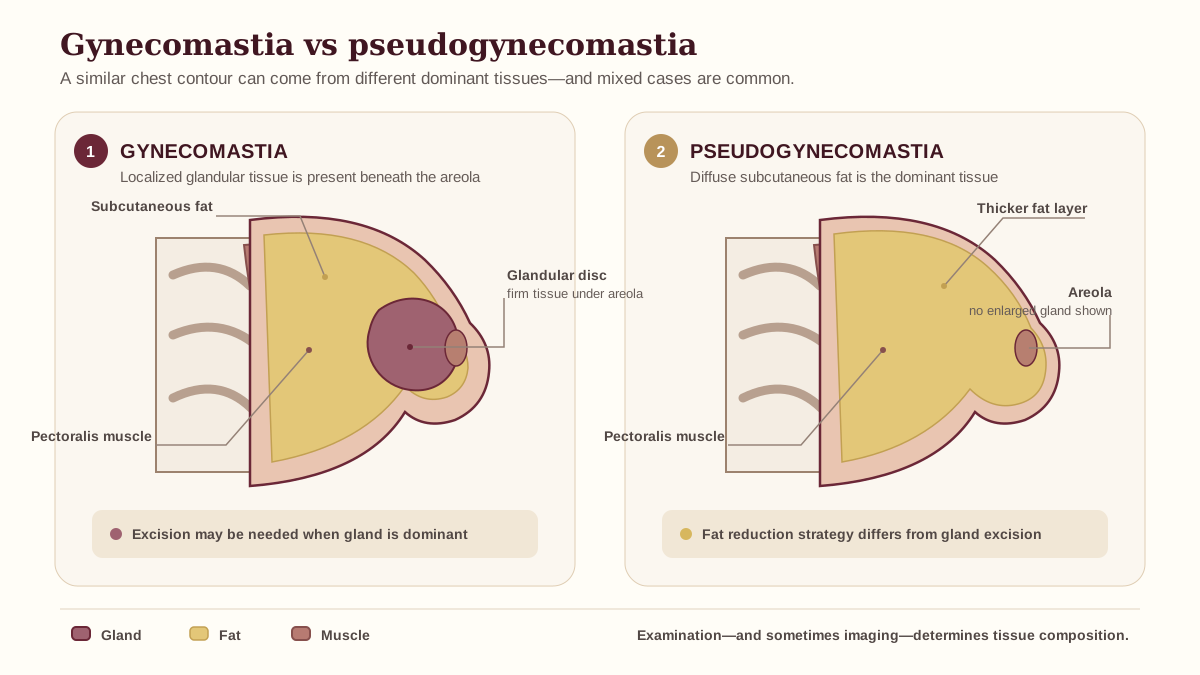
Gynecomastia is the enlargement of actual glandular breast tissue in a male chest, caused by a hormonal imbalance between estrogen and testosterone. Pseudogynecomastia, sometimes called "false gynecomastia," is simply an accumulation of fat in the same area, with no glandular growth involved. Both can produce a similar visual fullness under and around the nipple, which is exactly why they get confused — but only one of them is glandular tissue that behaves like breast tissue anywhere else in the body.
How Doctors Distinguish Them
Clinically, the distinction is usually made through a physical exam: a doctor palpates the area beneath the nipple, feeling for a firm, disc-shaped mass of glandular tissue versus a more diffuse, soft layer of fat. Pseudogynecomastia typically presents as circumferential fat in the subareolar area that tends to stay a similar size over time, while true gynecomastia has that distinct firm core.1 If there's uncertainty, or if a hard lump, asymmetry, skin changes, or nipple discharge is present, imaging such as ultrasound or mammography and lab work may be recommended to rule out other causes.
Gynecomastia is also clinically graded to guide treatment decisions. The most commonly used classification is the Simon grade:
- Grade I: Small enlargement without skin redundancy
- Grade IIa: Moderate enlargement without skin redundancy
- Grade IIb: Moderate enlargement with minor skin redundancy
- Grade III: Marked enlargement with significant skin redundancy
Grade affects surgical planning directly: lower grades can often be addressed with liposuction and targeted gland excision through a small periareolar incision, while Grade III cases may require excision of excess skin and a more complex reconstruction. Understanding where a patient falls on this spectrum is one reason a hands-on clinical assessment matters more than a photo review alone.
Self-Assessment Signs
You can get a general sense at home by gently pressing beneath the nipple: a firm, rubbery, somewhat mobile disc suggests glandular tissue, while an evenly soft, fatty feel throughout the chest suggests pseudogynecomastia. Tenderness, recent onset, or a lump that feels distinctly different from the surrounding tissue are reasons to see a doctor rather than guess. Self-assessment is a useful starting point, but it is not a diagnosis — many patients who are certain they have "just chest fat" turn out to have a glandular component too.
Why It Matters for Treatment
This distinction isn't academic — it directly determines what will actually work.
Pseudogynecomastia — Weight Loss Can Help
Because pseudogynecomastia is ordinary fat, it responds to the same weight-loss principles as fat anywhere else on the body: a caloric deficit combined with exercise can meaningfully reduce chest fullness in many patients. Spot-reduction through chest-focused exercise alone is not well supported, but overall fat loss can shrink this specific fat deposit along with others.
True Gynecomastia — Diet Won't Remove Glandular Tissue
Glandular breast tissue does not respond to caloric restriction or exercise, because it isn't fat — it's proliferated ductal and stromal tissue driven by hormonal signaling. Patients with true gynecomastia who diet and exercise extensively are often frustrated to find the fullness persists, which is itself a diagnostic clue pointing back toward a glandular cause rather than a fat one.
Mixed Cases
In practice, many patients have some combination of both: a firm glandular core surrounded by a layer of fat. This mixed presentation is common enough that surgical treatment plans are frequently designed around combining liposuction (for the fat component) with direct excision (for the glandular component), rather than relying on either approach alone.
Common Causes & When to Get Checked
Gynecomastia is most often idiopathic, but it's linked to hormonal shifts at predictable life stages: transiently in newborns due to maternal estrogen exposure, during puberty as testosterone and estradiol levels rebalance, and in men over 65 as testosterone naturally declines.1 It can also be triggered by certain medications (including some heart, ulcer, and hormone-related drugs), recreational drug use, or underlying conditions affecting the liver, kidney, thyroid, adrenal glands, or testes. Because gynecomastia can occasionally signal an underlying medical issue, a doctor's evaluation — rather than assuming it's cosmetic — is the responsible first step, especially for new-onset gynecomastia in an adult.
Medication-related gynecomastia is more common than most patients realize. Implicated drug classes include spironolactone (a diuretic), cimetidine (an older ulcer medication), anabolic steroids and testosterone supplementation (paradoxically, because the body converts excess androgens to estrogens), anti-androgens used in prostate cancer treatment, and certain antipsychotics and antidepressants. If a medication is the trigger, stopping or switching it (under physician supervision) sometimes resolves the gynecomastia partially or fully before surgery is considered.
| Feature | Gynecomastia | Pseudogynecomastia |
|---|---|---|
| Tissue type | Glandular breast tissue | Adipose (fat) |
| Palpable texture | Firm, rubbery disc under nipple | Soft, diffuse |
| Response to weight loss | None — glandular tissue stays | Can improve |
| Affected by hormones | Yes — estrogen/testosterone ratio | No |
| Surgical treatment | Gland excision ± liposuction | Liposuction alone often sufficient |
When It Resolves on Its Own
Pubertal gynecomastia frequently resolves without treatment as hormone levels stabilize, often within roughly 6 months to 2 years, so most surgeons and pediatricians recommend observation rather than rushing to surgery in adolescent patients. Cases that persist well beyond a year, that appeared in adulthood, or that are causing significant physical or psychological distress are less likely to resolve spontaneously and are more reasonably considered for treatment.
Importantly, gynecomastia that has been present for more than roughly two years often develops fibrosis — a hardening of the glandular tissue — which makes it even less likely to resolve without intervention and sometimes slightly more complex to excise surgically. This is one practical reason some physicians set a clearer expectation with patients: watchful waiting makes sense in the first year, but indefinite delay if the tissue persists can lead to a more established condition that's harder to treat.
For adolescent patients, the psychological impact deserves direct acknowledgment as a clinical consideration — chest appearance during the school-age and early adult years can significantly affect self-confidence and social participation. Watchful waiting is medically appropriate but shouldn't override a patient's documented distress when the tissue has clearly persisted beyond the expected resolution window.
Treatment Options: Liposuction, Excision or Both
When surgery is appropriate, the technique follows the tissue type: liposuction can address fat-dominant enlargement, while firm glandular tissue may require direct excision.1 Mixed-tissue cases may be treated with both techniques in a single procedure; the choice depends on examination and grade rather than a one-size-fits-all rule.
VASER liposuction is an ultrasound-assisted variation used in some gynecomastia operations. A retrospective multi-center study evaluated 960 patients treated with VASER-assisted liposuction plus gland excision across gynecomastia grades and reported high satisfaction with a low rate of minor complications.2 Because the study did not compare the combined method with each technique alone, it cannot establish superiority over either alternative.
Recovery from gynecomastia surgery typically involves a compression vest worn for several weeks to help the skin re-conform to the new contour, restricted upper-body activity for 2 to 4 weeks, and a gradual return to chest exercises over 6 to 8 weeks. Final contour — after any residual swelling has resolved — is generally visible at 3 to 6 months. Scarring from the periareolar incision is typically well-concealed along the lower edge of the areola, though scar maturation takes 12 to 18 months.
Cost & Insurance
Gynecomastia surgery is usually classified as cosmetic and paid out of pocket, though insurance coverage is occasionally considered in cases with a clear underlying medical cause and documented symptoms. For a full breakdown of typical pricing and the narrow circumstances where insurance may apply, see our gynecomastia surgery cost and insurance guide.
Frequently Asked Questions
How do I know if I have gynecomastia or just chest fat?
The main clue is texture: true gynecomastia usually feels like a firm, rubbery disc of tissue directly beneath the nipple, while pseudogynecomastia feels soft and diffuse, like fat anywhere else on the body. A physical exam by a doctor is the only reliable way to confirm which one you have, since the two can coexist.
Can gynecomastia go away with exercise or weight loss?
Weight loss can reduce pseudogynecomastia because it's made of ordinary fat, but it will not shrink true glandular gynecomastia tissue, since diet and exercise don't affect glandular growth. This is exactly why an accurate diagnosis before starting a fitness plan for chest appearance matters — see our gynecomastia guide.
Does gynecomastia go away on its own?
Often, yes, particularly in adolescent boys, where pubertal gynecomastia frequently resolves within about 6 months to 2 years as hormone levels stabilize. Cases that persist beyond roughly a year or that started in adulthood are less likely to resolve without treatment.
What causes gynecomastia in men?
The most common cause is a hormonal imbalance between estrogen and testosterone, which can occur at birth, during puberty, or with aging, but certain medications, recreational drug use, and underlying medical conditions affecting the liver, kidney, thyroid, or testes can also contribute. See our causes section above for when a medical workup is warranted.
Do I need surgery for gynecomastia?
Not always — many cases, especially in teenagers or when a medication is the trigger, are managed with observation or addressing the underlying cause first. Surgery is generally reserved for long-standing, bothersome glandular tissue — see our cost and insurance guide for what typically qualifies.
Can gynecomastia and pseudogynecomastia occur together?
Yes — this is actually the most common presentation clinically, where a patient has both a firm glandular component and a layer of surrounding fat. This mixed picture is one reason surgical treatment often combines liposuction with direct gland excision rather than using either technique alone.