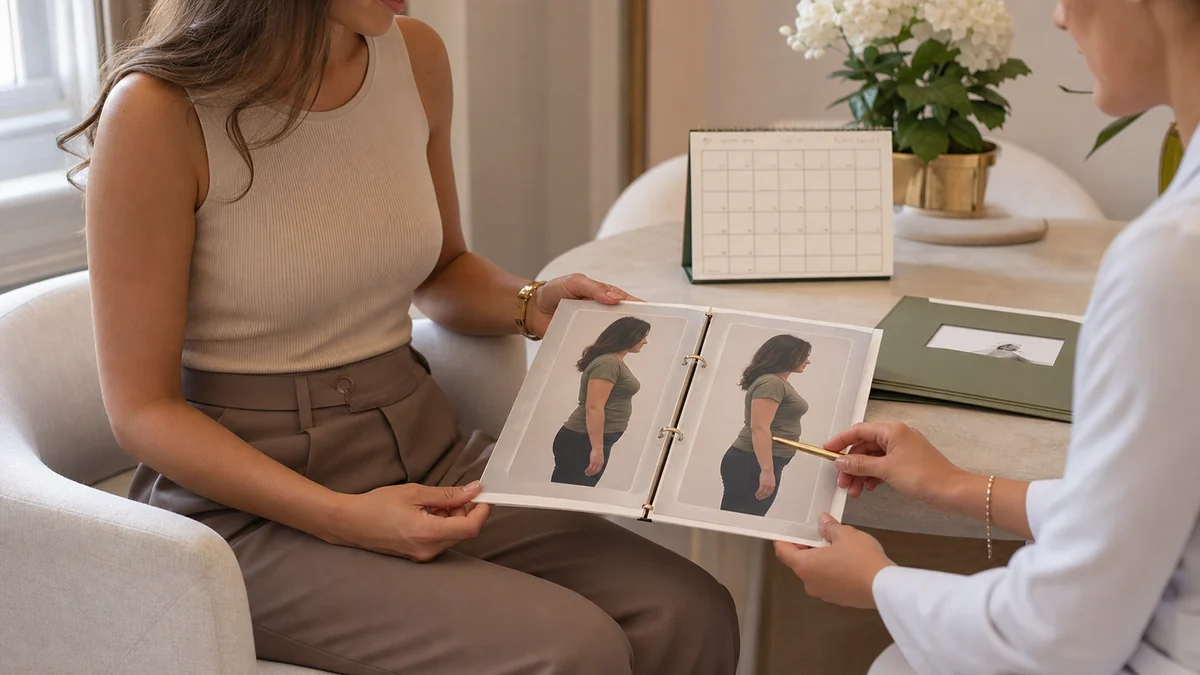
Mommy makeover before and after photos can look very different from patient to patient because “mommy makeover” is not a standardized operation; it is a personalized combination of procedures. Understanding exactly what is in that combination is the first step to reading any result photo accurately. For the full procedure overview, see our mommy makeover guide.
What "Mommy Makeover" Includes
There's no fixed procedure list — "mommy makeover" is a marketing umbrella term describing a combination most commonly built from a tummy tuck (addressing abdominal skin laxity and rectus diastasis), breast surgery (a lift, augmentation, or both, addressing volume loss and sagging from breastfeeding), and sometimes liposuction to refine the waist or flanks. Some patients add labiaplasty, arm lift, or thigh lift depending on where pregnancy-related changes concentrated, but the core pairing is almost always abdomen plus breasts.
The specific mix is determined entirely by your individual anatomy and goals — not every patient needs, or should have, every component. A patient with excellent abdominal skin elasticity but significant breast deflation might need augmentation or lift without abdominoplasty. Another with a separated abdominal wall but stable breast volume might need only a tummy tuck. Treat any gallery labeled "mommy makeover" as meaningless until you know which procedures that specific patient actually had.
ASPS data separately tracks abdominoplasty and breast procedures, but it does not define or count “mommy makeover” as one standardized operation.2 The label can therefore describe very different combinations from one patient to another.
Why Results Vary So Much
Because the underlying procedure combination differs so much between patients, comparing your own goals to someone else's before-and-after photo is only meaningful if you know exactly which procedures that patient had. A patient who had only a tummy tuck and breast lift will show a very different transformation pattern than one who also had augmentation and liposuction — treat gallery comparisons with that context in mind.
Starting anatomy matters enormously. Patients who gained more weight during pregnancy, carried multiples, or have less skin elasticity will typically show more dramatic before-and-after differences — but also longer scars and more complex recovery. Age, smoking history, and prior abdominal surgery (C-section incisions, for example) all influence both candidacy and outcome. Two patients with the same procedure list can look quite different at six months post-op because of these baseline variables, not because one surgeon was necessarily "better."
Breast component choice drives visible variation too. Augmentation adds upper-pole fullness that a lift alone cannot; a lift without implants addresses sagging but may leave the breast smaller than pre-pregnancy if significant tissue was removed. See our breast lift vs implants guide if you're unsure which breast approach fits your post-pregnancy anatomy.
The Longer Timeline Behind Combined Results
Because multiple surgical sites are healing simultaneously, combined-procedure recovery generally takes longer than any single component would on its own — most patients need 4 to 6 weeks before returning to normal activity, and the fully settled aesthetic result across all treated areas can take 6 to 12 months to appear. Early post-op photos, especially of the abdomen, often show more residual swelling than a single-procedure recovery would at the same time point.
Abdominal swelling from a tummy tuck can persist for months, masking the final waistline contour even when breast results look closer to settled. Breast implants, if included, continue dropping and softening over the first several months. Liposuction areas may feel firm or lumpy during early healing before smoothing out. A "mommy makeover after" photo taken at eight weeks is almost certainly showing a still-in-progress result across at least one treated zone.
| Timepoint | Abdomen (tummy tuck) | Breast component | Photo reliability |
|---|---|---|---|
| 2 weeks | Garment wear, limited mobility | Swelling, bruising | Not representative |
| 6–8 weeks | Returning to light activity | Shape emerging | Still transitional |
| 3 months | Majority of swelling resolved | Near-settled if no implants | Reasonably representative |
| 6–12 months | Scar maturation ongoing | Implants fully settled | Most reliable comparison point |
Timing After Pregnancy & Breastfeeding
Most surgeons recommend waiting until you're finished having children and have stopped breastfeeding for at least several months, since a future pregnancy can substantially undo abdominal and breast results, and breastfeeding affects breast tissue and shape in ways that are better assessed once complete. Reaching a stable, near-final weight before surgery also helps ensure the results hold over time.
Hormonal fluctuations during breastfeeding can temporarily alter breast size and density, making it difficult to plan implant size or lift technique accurately. Many surgeons prefer a minimum of three to six months after weaning before evaluating breast tissue for surgery. Weight stability matters too — planning surgery while still losing postpartum weight means your surgeon is designing results for a moving target.
This timing guidance isn't about judgment on when to pursue surgery — it's about maximizing the durability of a significant financial and physical investment. If you're uncertain about future pregnancies, that's worth discussing openly; some patients choose to address the abdomen now and defer breast surgery, or vice versa.
Combined Surgery Means Combined Risk
It's important to be direct about this: combining procedures into one longer surgery is associated with a higher complication rate — including venous thromboembolism (VTE) risk tied to longer anesthesia time — than performing a single shorter procedure. A published analysis of abdominoplasty combined with other body-contouring procedures found that adding concurrent surgeries increased complication rates compared with abdominoplasty alone, with operative time and patient comorbidities among the contributing factors.1
This isn't a reason to avoid a mommy makeover outright, but it is a genuine safety conversation that should happen with your surgeon and anesthesiologist, including candid discussion of your personal risk factors — BMI, smoking status, history of blood clots, and any medications that affect clotting. Sequential staging (tummy tuck first, breast surgery later, for example) can reduce single-session risk at the cost of two recovery periods and potentially higher total cost.
See our guide to combined-procedure safety and mommy makeover cost guide for broader context on risk-benefit trade-offs and pricing. If you're considering surgery abroad, factor travel and aftercare access into the risk equation as well — combined procedures leave less margin for complications managed remotely.
Reading Photos Critically
As with any before-and-after comparison, pose, compression garments, lighting, and timing all affect how dramatic a result looks. A patient photographed in a flexed abdominal pose under studio lighting at six weeks post-op will look different from the same patient standing relaxed at twelve months. Compression garments smooth the waistline in early photos; strategic camera angles can exaggerate hourglass transformation.
Ask specifically which procedures were combined and how many months post-op the "after" photo represents before treating it as a preview of your own likely outcome. Request to see results from patients with a similar starting BMI, number of pregnancies, and procedure combination — not just the surgeon's most dramatic case. For a broader framework on evaluating surgical galleries, see how to read before-and-after photos critically.
If you're considering a mommy makeover, bring a prioritized list of which body areas bother you most — abdomen, breasts, or both equally — to your consultation. That ranking helps your surgeon recommend a combination that addresses your primary concerns first, whether in one session or staged across two.
Frequently Asked Questions
What's included in a mommy makeover?
There's no fixed package — "mommy makeover" describes a personalized combination of procedures, most commonly a tummy tuck, breast surgery (lift, augmentation, or both), and sometimes liposuction, chosen based on what pregnancy and breastfeeding changed for that individual patient.
How long is recovery?
Combining procedures generally means a longer recovery than any single surgery alone, often 4 to 6 weeks before returning to normal activity, since multiple surgical sites are healing simultaneously. Your specific timeline depends on exactly which procedures were combined.
How soon after childbirth?
Most surgeons recommend waiting until you're finished having children and have stopped breastfeeding for several months, allowing your body to return closer to its stable baseline weight and hormone levels first. This timing also reduces the chance that a future pregnancy would undo results.
Why do mommy makeover results vary so much?
Because "mommy makeover" isn't one procedure, results depend heavily on exactly which combination was performed, the starting anatomy, and how much correction each area needed. Comparing your own goals to someone else's result is only meaningful if the underlying procedure combination is similar.
Is combining procedures riskier than having them separately?
Combining procedures generally means longer total anesthesia and surgical time, which is associated with somewhat higher complication rates than a single shorter procedure. This is a genuine trade-off worth discussing directly with your surgeon and anesthesiologist.
Can a mommy makeover be done in stages instead of all at once?
Yes, some patients and surgeons prefer to stage procedures across separate surgeries rather than combining everything in one session, which can reduce single-surgery risk at the cost of two separate recovery periods.