
Nose job before and after photos are some of the most searched cosmetic surgery content online, and also some of the most likely to be misread, because rhinoplasty has an unusually long and unpredictable healing timeline. A result that looks "off" at six weeks can look completely different — and often much better — a year later. Understanding this timeline is essential before judging any photo, including your own recovery.
What Rhinoplasty Can Change (and How Much)
Rhinoplasty can adjust the dorsum (bridge) height and shape, tip projection and refinement, nostril width, and the nose's overall proportion relative to the rest of the face.1 All of these changes happen within the boundaries set by your existing skin thickness, cartilage strength, and underlying bone — a surgeon reshapes what's there rather than building something entirely unrelated to your native anatomy.
Skin thickness is a particularly important variable that is rarely discussed in galleries but matters enormously to outcomes. Patients with thinner skin will see tip refinement more clearly because subtle cartilage work shows through the overlying tissue; patients with thicker skin have natural camouflage of underlying structure but may also see less sharp definition after tip work. Neither is better or worse — they are factors a surgeon works with rather than against. Cartilage quality and elasticity also vary by individual and affect how grafts behave during the multi-year maturation phase.
| Rhinoplasty CAN address | Rhinoplasty CANNOT address |
|---|---|
| Bridge (dorsum) height and width | Skin texture, pores, or surface irregularities |
| Tip projection, rotation, and definition | Breathing problems caused by non-structural sources |
| Nostril width and flare | Creating a nose unrelated to your underlying bone/cartilage |
| Nasal asymmetry (within cartilage limits) | Erasing scars from prior trauma without additional care |
| Hump reduction or camouflage | Results that ignore your facial proportions entirely |
It's also worth understanding the difference between open and closed rhinoplasty. Open rhinoplasty uses a small external incision at the columella (the strip between the nostrils) for direct access to underlying structures — useful for complex or revision cases. Closed rhinoplasty is done entirely through the nostrils with no external scar. Both are legitimate; which is more appropriate depends on what changes are planned and the surgeon's expertise. For patients considering non-surgical rhinoplasty via filler, the scope of change is much narrower — and the nose is a particularly high-risk injection site for vascular complications, including skin necrosis and, in rare cases, vision loss.3 That is a fundamentally different discussion from surgical planning.
Why Final Results Take a Year (or More)
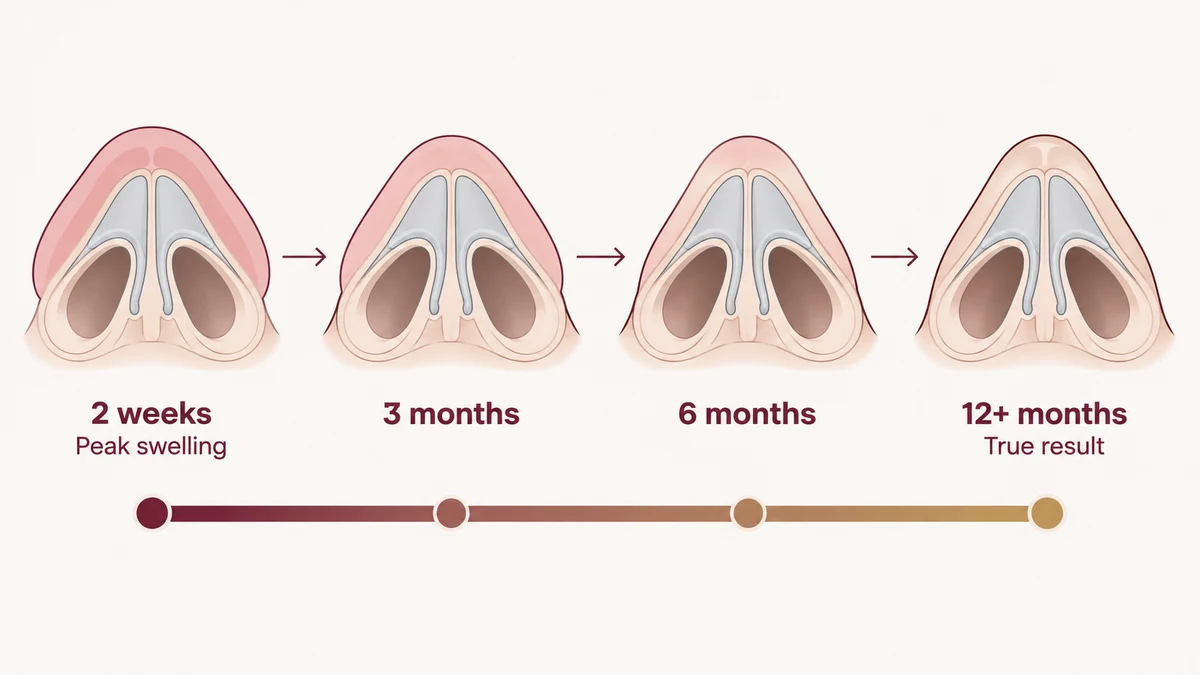
Unlike many facial procedures, rhinoplasty swelling resolves unevenly: the bridge tends to look close to final within a few months, but the nasal tip — which has thicker skin, more delicate blood supply, and less structural support — remains swollen the longest, sometimes taking up to a full year or more to fully refine. An "after" photo taken at 6 or even 12 weeks is very likely still showing a rounder, less-defined tip than the eventual result.
Here is a practical breakdown of what to expect at each recovery milestone:
- Weeks 1–2: Splint removed around day 7–10. Significant bruising and periorbital swelling. The nose looks larger than it will ultimately appear — this is edema, not the result.
- Months 1–3: Most visible bruising resolves. The bridge approaches its final profile first. The tip remains visibly swollen, may feel firm or numb, and will look rounder than the final outcome. Social presentability improves substantially.
- Months 3–6: Progressive tip refinement as edema dissipates. Most patients are comfortable in public. The nose is closer to final but still not fully settled.
- Months 6–12: Subtle continued refinement, especially at the tip. Skin gradually re-drapes over the revised cartilage framework. Some patients notice meaningful change still occurring in this window.
- 12+ months: Considered the established-result window. Concerns at this stage warrant a genuine conversation with your surgeon, rather than continued waiting.
ASPS notes that initial swelling subsides within weeks but nasal contour refinement can continue for up to a year, with swelling fluctuating during that period.2 Patience through this timeline is one of the most important — and least discussed — aspects of the rhinoplasty experience.
Facial Harmony Over "Perfect Nose"
A nose that looks striking in isolation on someone else's face may look disproportionate on yours, because a well-planned rhinoplasty is designed around facial harmony — how the nose relates to your chin, forehead, and overall facial proportions — rather than chasing a single universally "ideal" shape. Surgeons who prioritize this individualized approach over a template result tend to produce outcomes that age and read as natural for longer.
Classic aesthetic measurements inform surgical planning: the nasofacial angle (ideally approximately 30–40 degrees from the facial plane), the nasolabial angle (roughly 90–115 degrees depending on sex and preference), and the division of the face into balanced horizontal thirds all serve as guides for proportional planning. These are guidelines for achieving balance — not absolute targets to hit regardless of the individual's starting anatomy or goals.
A common consultation mistake is selecting a reference photo from a celebrity or influencer and asking for that specific nose shape. The problem isn't seeking inspiration — it's that the same nasal shape reads harmoniously on one face and oddly prominent on another. A good consultation translates your goal (usually: a nose that feels balanced and doesn't command the face) into what's achievable for your specific anatomy, which may look very different from the reference image.
Some patients also underestimate the role the chin plays in nasal perception. A recessed chin can make a proportional nose appear disproportionately large from the side. Some surgeons discuss chin projection in the same rhinoplasty consultation — not necessarily recommending additional surgery, but ensuring the nasal goal makes sense for the full facial context rather than in isolation.
Ethnic & Preservation Approaches
Preservation and ethnic rhinoplasty techniques are specifically designed to refine the nose's proportions while maintaining features consistent with a patient's heritage and identity, rather than converting every nose toward one standardized shape. This is a matter of surgical philosophy and technique that's worth raising directly during your consultation — see our ethnic rhinoplasty guide for a deeper look at anatomic considerations and identity-conscious planning.
Preservation rhinoplasty as a technical approach refers to how the dorsum is managed: rather than reducing the bridge by removing tissue (the traditional reduction approach), preservation techniques modify the underlying osseocartilaginous structure while maintaining the overlying soft-tissue envelope. This often produces a more natural-looking profile change and can reduce certain complications like prolonged swelling or bridge irregularities.
For patients with thicker skin — more common in patients of African, Middle Eastern, South Asian, or East Asian descent — rhinoplasty planning often requires a meaningfully different approach to tip definition. Simply reducing cartilage beneath thick skin typically produces less visible refinement than with thinner skin, because the overlying tissue conceals the structural work. Structural support techniques — adding cartilage grafts to create a stable framework the skin re-drapes over — often produce more predictable outcomes in these cases, though they require careful judgment about the appropriate degree of definition for the patient's specific skin type and aesthetic goals.
The most useful question to ask a prospective rhinoplasty surgeon isn't "how many rhinoplasties have you done?" but "how much experience do you have with patients of similar anatomy to mine?" Relevant experience with a specific nasal phenotype is more predictive of your outcome than raw case volume alone.
When Results Disappoint: Revision Reality
If your result at 12+ months genuinely doesn't meet your goals — not just still-resolving swelling — revision rhinoplasty is an option, though it's technically more demanding than a first-time procedure due to scar tissue and often-depleted native cartilage for grafting. Most surgeons recommend waiting at least a full year after the original surgery before any revision assessment, precisely because the tissue needs that long to fully settle before an accurate clinical judgment can be made.
Rhinoplasty planning is technically demanding because small structural changes affect both appearance and, in some cases, airflow. Published revision rates vary by definition and patient population, so no single percentage should be treated as universal. This is not a reason to avoid the procedure; it is a reason to choose the original surgeon with care and discuss functional as well as aesthetic goals.
Revision rhinoplasty typically costs more than a primary procedure and often requires cartilage grafting from a secondary donor site — commonly the ear concha for minor revisions, or rib cartilage for more extensive structural rebuilding. If revision is performed by the original surgeon, they may offer reduced fees for minor adjustments — but this varies entirely by practice and is not a guarantee. If consulting a different surgeon, expect full pricing for a procedure that is generally more complex than the original surgery.
The right time to have the revision conversation is after the 12-month mark, with comparison photographs taken at multiple intervals through recovery. A surgeon can make a far more accurate assessment of what revision would require once the tissue has fully settled and the structural framework is stable.
Reading Photos Critically
Rhinoplasty before-and-after photos are among the most angle-sensitive in cosmetic surgery. A few degrees of camera rotation can make a bridge hump appear or disappear, and lighting alone can reshape the perceived tip. Knowing what to look for makes gallery comparison significantly more useful.
Camera angle is everything
Camera angle exaggerates or minimizes nasal dorsum height dramatically. A slightly upward camera angle (shooting from below) accentuates a dorsal hump, while a level or slightly downward angle can minimize it. Profile photos taken from different heights between "before" and "after" aren't showing equivalent anatomy — they're showing different perspectives of the same nose. Look for standardized head position and camera height in both frames.
Lighting and contouring
Side lighting creates a shadow along the bridge that emphasizes bumps and asymmetry, while flat front-facing light smooths contours. Contour makeup in the "after" photo — highlight along the bridge, shadow along the sides — can further refine the nasal silhouette in ways surgery didn't. Clinical photos should show bare skin in both frames.
Multiple angles matter
A result that looks excellent in profile can still show asymmetry, a deviated tip, or an overly pinched appearance from the front. The most informative galleries show the same patient from frontal, lateral (both sides), and oblique (three-quarter) views. A gallery that only shows profile photos is hiding the full picture.
Timing disclosure
"3-month postop" versus "12 months+" represent very different healing stages. At 3 months, the tip is still swollen and the bridge may still be settling. Galleries filled primarily with early photos likely understate the final result (since continued refinement occurs) or, conversely, show swelling-related tip fullness that will eventually resolve.
What rhinoplasty photos rarely show
- The nose in animation: Static photos don't show how the nose moves during smiling, laughing, or speaking. Tip dynamics — whether the tip droops when smiling, for example — are an important part of the result that no single photo captures.
- Breathing function: A nose that looks great in photos may or may not breathe well. Functional outcomes (nasal airway patency) are invisible in visual galleries but critically important if you have any pre-existing breathing concerns.
- The base view (worm's-eye): This angle shows nostril symmetry, alar width, and columellar show. Most galleries omit this view, but it reveals information about tip work and nostril narrowing that other angles hide.
- Comparable starting anatomy: A dramatic bridge reduction in a patient with a large dorsal hump doesn't directly predict results for a tip-refinement case with different starting anatomy. Match your concern to similar starting cases.
- Skin thickness effects: Patients with thick nasal skin see less dramatic tip definition than those with thin skin, even with identical cartilage work. If your skin type isn't represented in the gallery, the apparent tip refinement isn't directly comparable.
Social media has added an additional layer of complexity: filtered or lightly edited before-and-after images circulate widely on platforms where timing is rarely disclosed and image manipulation is common. Verified gallery photographs from published case series or direct surgeon consultations remain more informative than curated social feeds. When in doubt, ask a prospective surgeon to show you a mature result in a case with anatomy similar to yours and to state exactly when the photograph was taken.
Frequently Asked Questions
How long until my nose looks final?
Most swelling resolves substantially within a few months, but the nasal tip — the last area to fully settle — can continue subtly refining for up to a year or occasionally longer. Photos taken before that window has passed are showing a still-changing result, not the final one.
Can rhinoplasty keep my ethnic features?
Yes — modern preservation and ethnic rhinoplasty approaches are specifically designed to refine the nose while maintaining features consistent with your heritage, rather than converting it to a single standardized shape.
How common is revision?
Revision rates vary by surgeon experience and case complexity, but rhinoplasty is generally recognized as one of the more technically demanding procedures in plastic surgery. See our revision rhinoplasty guide for what the process involves.
What can rhinoplasty realistically change?
Rhinoplasty can adjust the bridge (dorsum), tip shape and projection, nostril width, and overall proportion relative to the rest of the face. It works within the limits of your existing skin, cartilage, and bone structure.
Why does the nasal tip take longest to heal?
The tip has thicker skin and more delicate blood supply and cartilage support than the bridge, so swelling resolves there more slowly and unevenly. This is a well-recognized pattern in rhinoplasty recovery, not a sign that something has gone wrong.
Should I bring reference photos to my consultation?
Reference photos can help communicate your general aesthetic goals, but your surgeon should adapt any inspiration to your own skin thickness, bone structure, and facial proportions rather than attempting to replicate someone else's nose exactly.