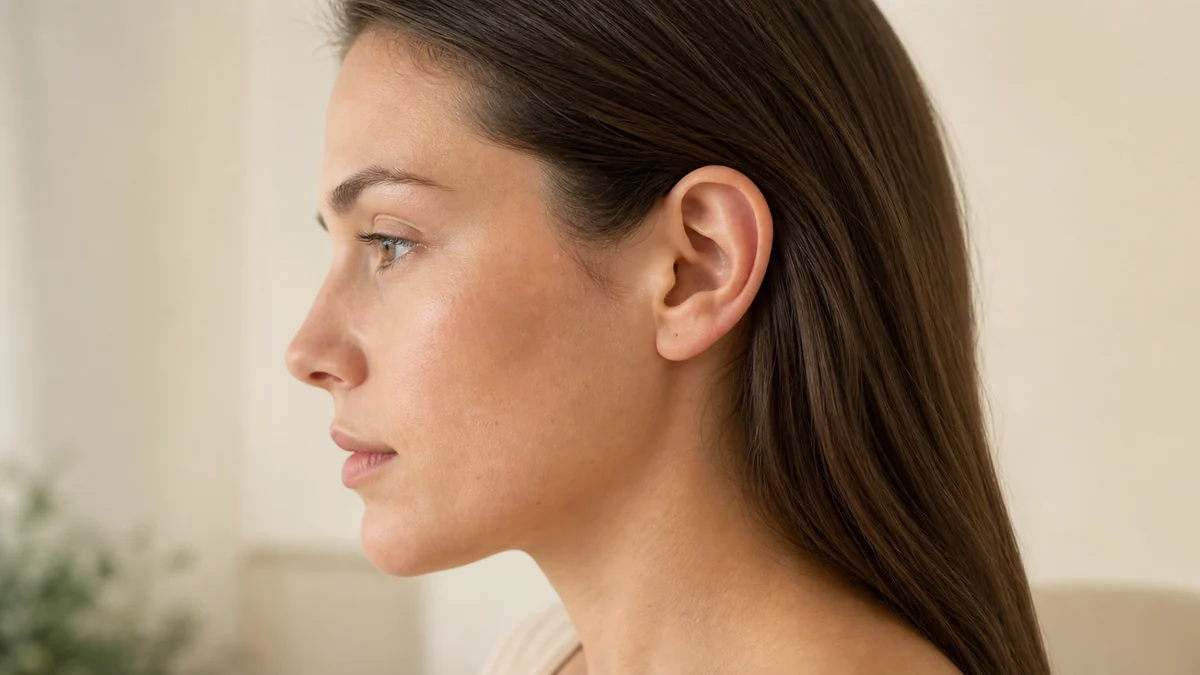
Otoplasty — sometimes called ear pinning — reshapes or repositions the external ear to reduce prominence or correct congenital shape variations. It is one of the few cosmetic procedures regularly performed on children, typically starting around school age, though adults pursue it with equal surgical logic and no upper age limit. Age guidance, technique comparison, and the headband protocol are covered in the sections below.
What Is Otoplasty?
Otoplasty addresses the external ear (pinna) — not hearing structures. The most common goal is reducing ear prominence: ears that stick out further from the head than average, often due to underdeveloped antihelical fold, conchal bowl hypertrophy, or a combination. Other indications include correcting lop ear, cup ear, or asymmetric ear shape.
Surgery is performed through an incision hidden in the crease behind the ear, where scars are not visible from the front or side in normal social interaction. The surgeon reshapes cartilage using sutures, scoring (weakening cartilage to allow bending), or a combination — selecting technique based on which anatomical feature drives the prominence. StatPearls describes otoplasty as correcting protruding ears and other auricular deformities through cartilage modification behind the ear.1
Common anatomical causes of prominence include an underdeveloped antihelical fold (the natural crease that folds the upper ear inward), an overdeveloped conchal bowl (the cup-shaped central portion), or a combination of both. Each cause responds to different surgical maneuvers — fold creation via sutures, conchal reduction via cartilage excision, or combined approaches. Misidentifying the primary cause leads to undercorrection or unnatural pinna shape.
The "normal" ear protrudes roughly 20 to 30 millimeters from the skull at the upper helix — otoplasty aims to reduce projection to a range that appears natural from front and profile views without creating a pinned-flat appearance. Overcorrection is a recognized complication of aggressive suturing or excessive conchal reduction.
Results are generally permanent once healing completes, though cartilage memory and suture integrity over decades mean a small recurrence rate is possible — particularly if post-operative protection protocols are not followed during early healing.
Am I (or My Child) a Candidate?
Good candidates — child or adult — have prominent or irregularly shaped ears they wish to change, are in good general health, and have realistic expectations about what surgery can achieve. For children, the timing question matters: operating too early, before ear growth is near complete, risks results that do not match adult ear proportions.
Most sources recommend waiting until approximately age 5 to 6, when the ear has reached roughly 80 to 90 percent of adult size — old enough for stable surgical planning, yet early enough that school-age social experiences benefit from correction before teasing becomes entrenched.1 Equally important: the child should express some genuine willingness rather than the decision being purely parental.
Adults have no upper age limit. Cartilage is firmer and less pliable than in children, which can require slightly more aggressive scoring, but the fundamental technique and expected outcome are the same. Patients with active ear infection, bleeding disorders, or unrealistic expectations about complete symmetry need candid discussion before proceeding.
Otoplasty does not change hearing — the external pinna contributes minimally to auditory function in most cases, and surgery avoids middle- or inner-ear structures. Patients sometimes confuse cosmetic ear surgery with procedures to address hearing loss; these are entirely separate medical pathways. Prominent ears are a shape and position concern, not a hearing impairment.
The Procedure & Anesthesia
Children typically receive general anesthesia in an accredited facility — a one- to two-hour outpatient procedure treating one or both ears. Adults may undergo general anesthesia or local anesthesia with sedation depending on preference, extent, and surgeon protocol.
Mustarde suture technique uses permanent or long-lasting sutures placed through the cartilage behind the ear to create or reinforce the antihelical fold, pulling the ear closer to the head without removing cartilage. Cartilage-scoring techniques (such as anterior scoring) weaken cartilage on the front surface so it bends toward the head — effective when cartilage is stiff, particularly in adults. Many cases combine both approaches.
Conchal bowl reduction — removing a crescent of cartilage or soft tissue from the concha — addresses another common cause of prominence when the entire ear bowl pushes the pinna forward. The surgeon selects technique based on physical exam, not a one-size-fits-all approach. Bandages or a protective wrap are applied immediately post-op.
Bilateral otoplasty (both ears) is standard when prominence is symmetric — treating one ear alone can create a new asymmetry relative to the untreated side. Minor asymmetry pre-exists in most ears naturally; the goal is improvement toward balance, not mathematical perfection visible only on close measurement. Revision otoplasty for undercorrection or recurrence is uncommon but possible years later if sutures loosen or cartilage memory reasserts.
Recovery Timeline
Otoplasty recovery is relatively short compared with many cosmetic procedures, but protecting the new ear position during early healing is critical — cartilage holds its new shape only after scar tissue stabilizes it.
Days 1–7: Mild discomfort, swelling, and bruising around the ears. Pain managed with oral medication. A protective headband or dressing keeps ears in position continuously. Children typically return to school within about a week; adults to desk work similarly, avoiding activities that risk ear trauma.
Sleep position matters during early recovery — back sleeping reduces pressure on freshly repositioned cartilage. Side sleepers may need extra pillow support to avoid folding one ear forward against the mattress. Your surgeon will specify when side sleeping is safe again, typically after the continuous headband phase ends.
Weeks 2–6: Headband worn at night (and sometimes during the day per surgeon protocol) to prevent accidental folding during sleep. Strenuous activity and contact sports deferred. Sutures may be absorbable or removed at one to two weeks depending on technique.
Months 2–6: Swelling fully resolves and final ear position becomes apparent. See our post-surgery warning signs guide for symptoms requiring urgent attention.
Children returning to school should avoid playground activities that risk direct ear impact until cleared — contact sports, wrestling, and rough play pose the highest early recurrence risk. Adults should similarly defer contact sports until the surgeon confirms cartilage stabilization, typically around six to eight weeks minimum.
Results & Longevity
Successful otoplasty produces ears that sit closer to the head with a natural-appearing fold and contour — not pinned flat unnaturally. Overcorrection (ears too close to the head) is a recognized complication of aggressive technique; undercorrection or partial recurrence can occur if sutures fail or cartilage memory reasserts.
Results are generally permanent in the sense that the structural change persists, though long-term data show a small percentage of patients may seek revision for asymmetry or partial recurrence years later. Before-and-after photos should be evaluated at minimum three to six months post-op, not during early swelling. ASPS notes that otoplasty results are typically long-lasting when post-operative care instructions are followed.2
Parents researching otoplasty for a child should involve the child in age-appropriate conversation rather than treating the decision as entirely adult-driven. Psychological readiness matters alongside anatomical readiness — a child who is actively distressed by teasing may benefit more than one who has not yet noticed or internalized ear appearance.
Risks & Complications
General surgical risks include infection, bleeding, hematoma, and unfavorable scarring behind the ear. Otoplasty-specific risks include asymmetry, overcorrection, undercorrection, suture extrusion (sutures working their way to the surface), cartilage irregularity, and partial recurrence of prominence.
Hematoma behind the ear requires prompt drainage — it can compromise cartilage blood supply if left untreated. Signs include sudden increased pain, swelling, and tightness on one side disproportionate to the other. Choosing a surgeon experienced in otoplasty specifically — not just general cosmetic surgery — reduces technique-related complications.
Telemedicine consultations can help screen candidacy but cannot replace an in-person ear examination — cartilage stiffness, asymmetry, and conchal depth are assessed by physical exam. Photos alone miss subtle unilateral prominence or lop-ear variants that change technique selection.
Our guide on verifying credentials explains how to confirm board certification. For facial plastic surgery specifically, ABPS or ABFPRS certification indicates relevant training.
Cost
Otoplasty in the US typically costs $3,500 to $6,000 total, including surgeon's fee, anesthesia, and facility fee. Bilateral (both ears) treatment, general anesthesia in children, and high-cost metro areas push toward the upper end. Insurance rarely covers cosmetic otoplasty; reconstructive exceptions for specific congenital deformities are uncommon.
See our cost guide for procedure comparisons and our financing guide for payment options. ASPS procedural statistics provide context on otoplasty demand.3
Revision otoplasty rates are low but not zero — suture failure, trauma before healing completes, or cartilage memory can cause partial recurrence. Choosing a surgeon who performs otoplasty regularly (not occasionally among other procedures) and following headband protocol precisely reduces this risk. Adults who delayed surgery from childhood carry the same surgical logic; stigma or self-consciousness alone are valid motivations when expectations are realistic.
Both ears are typically treated in one session when bilateral prominence is the concern — asymmetric treatment of a single ear can make the untreated side appear relatively prominent afterward. Minor pre-existing asymmetry is normal; surgery aims for balanced improvement, not identical mirror-image ears on close inspection.
Frequently Asked Questions
What does otoplasty correct?
Otoplasty most commonly corrects prominent ears that stick out further than average, and can also address other shape variations like a folded or constricted ear. The candidacy section above covers how each variation is assessed and treated.
What age is best for children?
Most surgeons recommend around age 5 to 6, once the ear has reached roughly 80 to 90 percent of adult size. See the candidacy section for why the child's own comfort with the decision matters.
How much does otoplasty cost?
In the US, otoplasty typically costs $3,500 to $6,000. See our cost guide for a broader comparison across procedures.
Is otoplasty performed on adults too?
Yes — there is no upper age limit, and adults undergo essentially the same technique as children, just with firmer, slightly less pliable cartilage to reshape. See our full guide for adult-specific recovery considerations.
Do otoplasty results last?
Results are generally permanent when healing completes. A protective headband protocol during early recovery helps protect the new position while scar tissue stabilizes the cartilage.
Does insurance cover otoplasty?
Rarely — otoplasty is classified as cosmetic in the vast majority of cases. See our insurance coverage guide for general criteria.