
Search "BBL before and after" and you'll find thousands of dramatic transformation photos. What you won't find, in most of those galleries, is any explanation of why two photos of similar patients can look so different — or an honest accounting of what determines whether your own result will match what you're looking at. This guide is not a gallery. It's a framework for reading BBL result photos the way a clinician would: understanding what's actually being shown, what's being hidden by pose and timing, and where the real safety conversation belongs in your decision.
Why BBL Photos Can Mislead
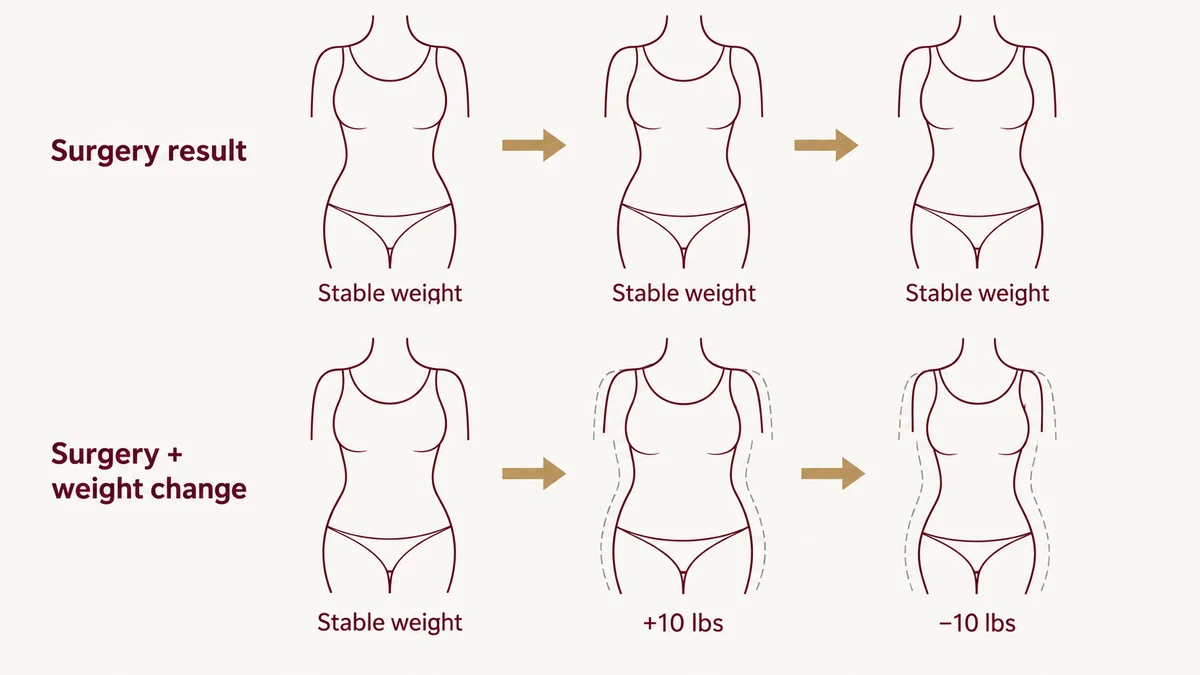
Before-and-after photography is not neutral documentation — it's a presentation choice, and small choices compound into large differences in how a result appears.
Pose, Lighting, Angle & Compression
The same patient photographed from a slightly higher camera angle, under harder side lighting, in a posture that subtly arches the lower back, can look meaningfully more dramatic than in a neutral standing pose under flat lighting. Compression garments worn in "after" photos smooth the surrounding tissue and can visually exaggerate projection. None of this is necessarily dishonest — it's simply how portrait photography works — but it means two photos are rarely an apples-to-apples comparison unless the conditions are matched.
Timing — Early Post-Op vs Final Result
Many gallery photos are taken at 2 to 6 weeks after surgery, when the treated area is still swollen from the procedure itself. This early swelling can make the buttocks appear larger and rounder than the eventual, settled result once inflammation resolves and the surviving fat volume stabilizes — usually not until the 3 to 6 month mark. A photo captioned "after" without a timestamp could be showing a temporary, swelling-inflated version of the outcome rather than the final one.
Editing & Selection Bias
Surgeons and marketing teams naturally select their most flattering, most successful cases for public galleries — this is standard practice, not necessarily deception, but it does mean a gallery represents a curated best-case sample, not an average outcome. Basic photo editing (brightness, contrast, occasionally more) can further widen the gap between the marketing photo and what most patients should expect.
What BBL Photos Rarely Show
- The result while sitting: BBL photos are almost always taken standing. How the transferred fat looks and feels when sitting — where compression and shape change are most apparent — is rarely photographed but is relevant to daily life.
- Donor site changes: The liposuction sites (abdomen, flanks, thighs) are an integral part of the visual result but often cropped out of gluteal-focused photos. The overall body contour change includes both where fat was removed and where it was added.
- Weight fluctuation effects: Transferred fat behaves like any other fat in the body — it grows with weight gain and shrinks with weight loss. Galleries don't show how results change with 10–15 pounds of fluctuation, which is common in real life.
- Asymmetry in natural poses: Studio photos are taken in controlled, symmetrical stances. Natural standing, walking, or clothing drape may reveal asymmetry that controlled photography minimizes.
- Long-term settling at 2+ years: Most galleries show 3–12 month results. How the transferred fat integrates and settles over multiple years — including continued volume loss in some patients — is rarely documented.
What Actually Determines Your Result
Four variables matter more than any single surgeon's technique or marketing photos: how much donor fat is available for harvest, your individual body mass index and skin quality, the fat survival rate achieved by the surgical team's technique, and the injection volume chosen relative to what your anatomy can safely accommodate. A surgeon working with a slimmer patient simply has less raw material to work with than one working with a patient who has more donor fat in the abdomen, flanks, or thighs — this is a physical constraint, not a skill gap. See what a "skinny BBL" really means for how this plays out in lower-BMI patients.
How Much Fat "Survives"?
Not all transferred fat remains permanently. A prospective ultrasound study of subcutaneous-only gluteal fat grafting found an average 12-month retention of roughly 82% of the injected volume, using a moderate injection volume protocol.2 A larger retrospective safety series of 7,000 consecutive cases using higher average injection volumes (around 1,200 cc per buttock) reported an estimated fat graft survival closer to 70%.3 The pattern across the literature is consistent: retention tends to run lower as injected volume increases, meaning a request for maximum possible volume often trades away some percentage of long-term retention.
Realistic Timeline: When You See the Final Shape
Immediately after surgery, the buttocks are swollen and the result looks larger than it will ultimately be. Over the following weeks, swelling gradually resolves and some of the transferred fat is naturally reabsorbed by the body — this is the expected biological process, not a complication. Most surgeons and patients consider the 3 to 6 month mark the point at which the "final" shape has stabilized, though subtle softening can continue for up to a year. Any before-and-after comparison photographed before this window has elapsed should be read as a progress photo, not a final result.
| Timepoint | What's Happening | Photo Reliability |
|---|---|---|
| 1–2 weeks | Peak swelling, bruising, limited sitting | Not representative — swelling inflates apparent size |
| 4–6 weeks | Swelling declining, most activity resuming | Still transitional — some swelling remains |
| 3 months | Majority of fat survival outcome established | Reasonably representative |
| 6 months | Considered the settled, final result by most surgeons | Most reliable comparison point |
| 12 months | Long-term retention studies typically measure here | Gold standard for published outcome data |
"Skinny BBL" Results Are Different
Patients marketed a "skinny BBL" — a lower-BMI patient undergoing gluteal fat grafting — should expect a more subtle, contour-focused change rather than the dramatic volume increase often shown in viral before-and-after content. This isn't a limitation of the technique; it's a direct consequence of having less donor fat available to harvest and transfer in the first place. Our dedicated guide on what a skinny BBL actually involves covers donor-site limits and realistic expectations in more depth.
Before You Compare Photos: The Safety Question
It's worth pausing on aesthetics to note that gluteal fat grafting carries a real, well-documented safety profile that any responsible before-and-after conversation should include. A landmark industry task force survey found that fat injected into the deep gluteal muscle — rather than exclusively into the subcutaneous layer — was associated with significantly higher rates of fatal and non-fatal pulmonary fat embolism.1 A 2026 Level III retrospective series using a strict subcutaneous-only protocol reported zero embolic events across 7,000 cases; this is supportive observational evidence, not proof that BBL can be made risk-free.3 Current multisociety guidance also supports real-time ultrasound visualization of the cannula during injection in addition to subcutaneous-only placement, appropriate credentials and facility standards, and direct postoperative responsibility by the operating surgeon.4 In practice, this means the single most important question about any surgeon's gallery isn't "how good do the photos look" — it's whether that surgeon can confirm these safeguards in writing. For the full risk picture, see our dedicated BBL safety guide.
Questions to Ask About a Surgeon's Before & After Gallery
Before treating any gallery as a preview of your own outcome, it's reasonable to ask the surgeon directly:
- How many months after surgery was this "after" photo taken?
- Is this patient's build (BMI, donor fat, skin quality) comparable to mine?
- What injection volume was used, and what would you recommend for me?
- Can you confirm your injection technique is subcutaneous-only?
- What percentage of your gallery patients would you say this result represents — a typical case or a best case?
A surgeon who answers these questions directly, with specifics, is demonstrating exactly the kind of transparency this guide is trying to encourage. For a broader framework on evaluating any cosmetic surgeon, see how to read before-and-after photos critically and how to verify a surgeon's credentials before booking a consultation.
Frequently Asked Questions
How long until BBL results are final?
Most patients see their final shape at 3 to 6 months after surgery, once swelling has fully resolved and the surviving fat has stabilized. Early photos taken at 2 to 4 weeks show a temporarily larger, swollen result that will shrink as inflammation settles — see our recovery timelines for the week-by-week pattern.
How much of the transferred fat survives?
Published studies report gluteal fat graft survival in the range of roughly 65 to 82 percent at 12 months when injection is subcutaneous-only, though rates vary by surgeon technique, volume injected, and individual biology — see our BBL safety guide for why the injection plane matters. Higher injection volumes tend to show proportionally lower percentage retention.
Why do BBL before and after photos look so different from real life?
Pose, lighting, camera angle, compression garments, and the timing of the photo relative to surgery all change how a result appears. Learn how to read before-and-after photos critically — a patient photographed in a tightening pose under flattering studio lighting at peak post-op swelling can look dramatically different from the same patient standing naturally eight months later.
Does a BBL last forever?
The fat that survives the initial healing period is generally considered permanent living tissue, but it can still shrink or grow with significant weight changes, since it behaves like any other fat in the body. Aging and weight fluctuation affect a BBL result the same way they affect fat anywhere else.
Can you get a BBL if you're slim?
Yes, but donor fat availability limits how much volume can realistically be transferred, which is why results in slimmer patients — sometimes marketed as a "skinny BBL" — tend to be more subtle and contour-focused rather than dramatic. See our skinny BBL guide for what to realistically expect.
What if my results don't match the photos I was shown?
Ask your surgeon directly whether you're still within the normal 3 to 6 month settling window before drawing conclusions, since early results are not final — see our recovery timelines. If you're well past that window and genuinely dissatisfied, a documented conversation about revision options is the appropriate next step, not comparison shopping based on someone else's gallery.