
Lip lift before and after content on social media tends to emphasize the dramatic increase in visible pink lip — but rarely discusses the permanent scar involved, the narrow candidacy window, or how a lift fundamentally differs from filler. Since this procedure makes a structural, non-reversible change to your face, it deserves a more complete picture before you decide it's right for you.
What a Lip Lift Does
A lip lift shortens the philtrum — the vertical space between the base of the nose and the upper lip border — which permanently increases how much pink lip shows both at rest and while smiling. The most common variant is the bullhorn subnasal lip lift, named for the curved incision pattern that follows the contours of both nostrils and hides the resulting scar within the natural nostril sill crease.
To understand what this achieves, think of the philtrum as a frame around the upper lip. When that frame is shorter, more of the vermilion is on display. A systematic review describes surgical upper-lip-lift techniques as tissue-repositioning procedures and distinguishes them from injectable approaches.1
What a lip lift does not do: it doesn't add volume, plumpness, or projection to the lip itself. A patient who already shows good upper lip tissue but simply wants fuller, more projected lips is not the right candidate — they're describing a filler or fat transfer outcome. Distinguishing between "I want more lip show" and "I want bigger lips" is one of the most important conversations to have at consultation.
The procedure typically takes 60 to 90 minutes under local anesthesia with or without sedation. A precise strip of skin is excised, the underlying tissue is suspended, and the wound is closed with fine sutures. Swelling and mild distortion of the upper lip area is expected for the first 2–3 weeks, with the final contour becoming visible at 3–6 months once scar maturation is substantially complete.
Lip Lift vs Lip Filler
These two procedures are frequently compared — and frequently confused — because both visually change the upper lip area. The distinction comes down to what each actually modifies:
| Factor | Lip Lift | Lip Filler |
|---|---|---|
| What it changes | Philtrum length; structural lip show | Lip volume and projection |
| Duration | Permanent | 6–18 months typically |
| Reversible? | No | Yes (hyaluronidase) |
| Maintenance needed | None after healing | Repeat treatments every 6–12 months |
| Scar | Yes — at nasal base | No |
| Downtime | 1–2 weeks noticeable swelling | Hours to days minimal |
| Best for | Long philtrum, poor lip show | Thin lips with adequate philtrum |
Some patients choose to combine both — a lift for philtral proportion and filler for added fullness — but they address different problems and are not interchangeable. If philtrum length is already proportionate and the concern is primarily lip volume, a lift may not address the goal; candidacy requires direct facial assessment.
One practical note: if you're genuinely uncertain which you need, many surgeons suggest trying filler placed at the vermilion border first. The decision to lift is permanent; the decision to fill is not. Testing the effect of more lip show with temporary filler can help you evaluate whether a structural correction is what you're after before committing to surgery.
The Scar: Where It Sits and How It Heals
The incision is placed directly at the base of the nose, following the natural curved contour of the nostril sill on both sides — specifically chosen to camouflage the scar within an existing anatomical crease. It is a real, permanent scar, not an illusion — but in most patients it heals to become quite difficult to notice at conversational distances.
Healing timeline: In the first 2–4 weeks, the scar typically looks pink, slightly raised, and prominent as it contracts and stabilizes. Between 2–6 months, it usually softens and flattens considerably. Full scar maturation — the point at which the scar has largely stopped changing — takes 12 to 18 months in most patients. The final result is almost always less visible than it appeared at the 6-week mark.
What affects the final appearance: Skin tone and type matter significantly. Patients with Fitzpatrick skin types IV–VI have a higher baseline risk of post-inflammatory hyperpigmentation and, in some cases, hypertrophic scar formation. Consistent sun protection over the scar during the first year is strongly recommended, as UV exposure can cause lasting discoloration in this area. Silicone gel sheeting has weak-but-real evidence for reducing hypertrophic scar development when used consistently after wound closure,3 though outcomes vary and no topical treatment eliminates the mark entirely.
A practical step before booking: ask your prospective surgeon to show healed photos specifically of patients with your skin tone at six months and beyond. Surgeons who perform this procedure regularly should be able to provide these. Inability or unwillingness to share those examples is a legitimate concern.
Scar revision after a poorly healed lip lift is possible but adds complexity — another scar in the same narrow area, and diminishing soft tissue to work with. The clearest way to minimize this risk is selecting a surgeon with consistent, well-healed outcomes across a range of skin types, not just light-skin examples in a gallery.
Candidacy
Good candidates for a lip lift typically share a combination of the following:
- A philtrum length generally greater than 15–20 mm from the columella (nasal base) to the upper lip border
- Minimal or decreasing lip show, particularly at rest and while smiling
- Upper lip that has thinned and receded with age — a natural and common process
- Preference for a permanent correction rather than ongoing maintenance
- Realistic expectations about the scar, the recovery period, and the limits of what structural correction can and can't achieve
Patients whose philtrum is already proportionate but want more volume or projection are typically better served by fat transfer or hyaluronic acid filler. A lip lift in someone without a long philtrum can produce a strained, unnatural look — the ratio matters as much as the absolute millimeters removed.
Age is not a strict contraindication, but the conversation changes throughout life. Younger patients with genuinely long philtrums are good candidates when proportions support it. Older patients who have noticed progressive upper lip thinning and recession over decades are often excellent candidates, since the structural correction addresses a change that filler alone can't reverse. Patients with significant perioral lines or broader lip aging may need to combine a lift with additional treatments for a complete result.
Active smokers are generally advised to stop at least 4–6 weeks before surgery, as nicotine impairs wound healing and increases scar quality risks — more consequential here than in many other procedures because the facial scar is prominent during recovery.
Risks & Over-Correction
Like any surgical procedure, a lip lift carries general risks including infection, delayed healing, asymmetry, and anesthesia reaction. The most procedure-specific and widely discussed risk, however, is over-shortening the philtrum. Removing too much skin creates a result that is difficult or impossible to correct: an excessively elevated upper lip that exposes too much upper gum when smiling, strains the lip when closed, or has an unnatural, "pulled" aesthetic at rest.
Over-correction tends to occur when precise pre-incision measurements aren't taken, when the patient or surgeon aims for more dramatic change than the anatomy safely allows, or when post-operative swelling masks the degree of elevation during early healing. This is a recognized complication — not a fringe concern — which is why consultation should include a clear discussion of exactly how much philtrum shortening is planned and what that looks like proportionally on your specific face.
Other risks worth discussing with your surgeon:
- Temporary lip numbness — usually resolves within weeks to months as sensory nerves recover
- Asymmetry — mild asymmetry is common in healing and often self-corrects; significant asymmetry may require revision
- Upper lip stiffness or restricted movement — temporary, related to swelling and tissue reorganization
- Widened nasal base appearance — a known risk if the excision pattern isn't precisely designed; often avoidable with proper technique and conservative removal
Revision surgery after a poorly performed lip lift is among the more technically demanding scenarios in facial plastic surgery, because scar tissue replaces original anatomy and soft tissue mobility decreases. Choosing carefully the first time matters considerably more here than for many reversible or revisable cosmetic procedures.
Longevity
A lip lift is permanent: the strip of skin removed to shorten the philtrum does not grow back, and the structural relationship between nose and upper lip is permanently altered. This is the core appeal for patients weary of filler maintenance — but it also means there is no undo option if preferences change.
Permanence does not mean the result is static forever. The lip continues to age after a lift, as all tissue does. Upper lip volume may thin somewhat over subsequent decades, and perioral skin will continue to develop fine lines with time — these changes happen regardless of surgery. A lip lift addresses one specific anatomical relationship (philtrum length), and the rest of the aging process continues independently. Some patients who had a lift in their 30s find that adding small amounts of filler to the body of the lip in their 50s gives the best combined outcome as general lip volume shifts with age.
See our guide on permanence and long-term facial aging for how structural changes generally interact with the face's continued evolution over decades — the considerations around permanence apply broadly across permanent facial procedures.
Reading Photos Critically
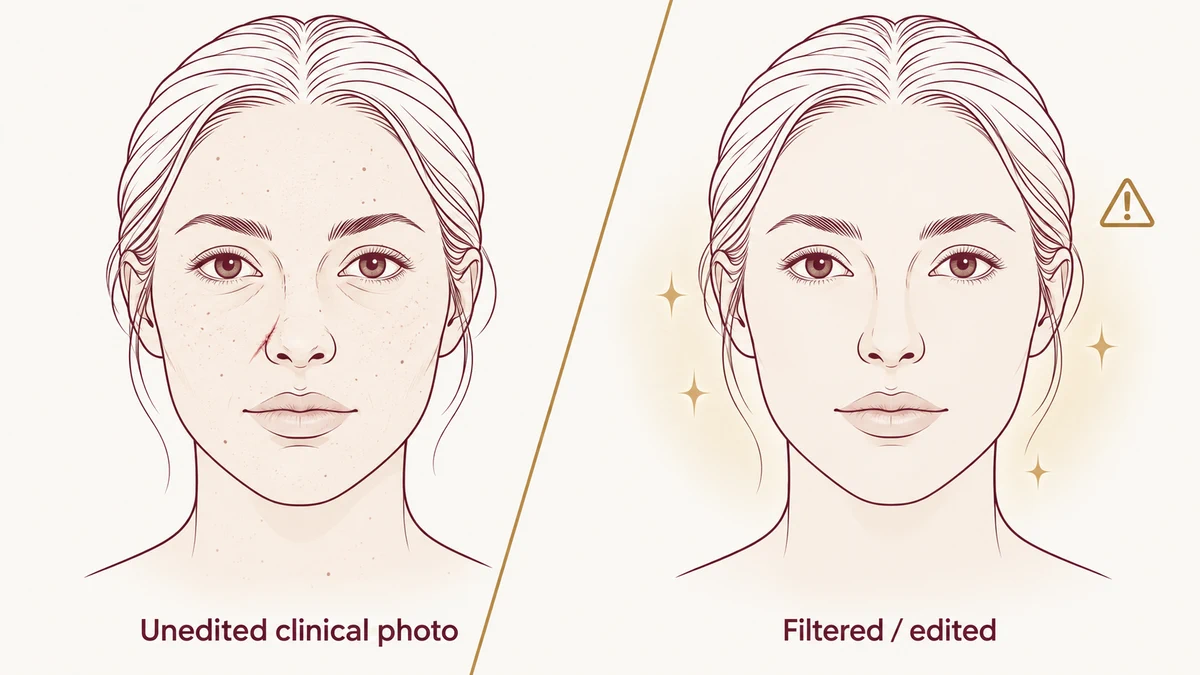
Lip lift before-and-after photos are uniquely susceptible to misleading presentation because the changes are measured in millimeters — and photographic variables can easily simulate or exaggerate a few millimeters of difference. Here's what to look for when evaluating a surgeon's gallery or social-media results.
Head tilt and chin position
The single biggest variable in lip lift photos. A slightly tilted-back head in the "after" image naturally shows more upper lip and vermilion from below, mimicking a more dramatic result than the surgery actually produced. Look for photos where the head is in the same neutral, straight-on position in both frames — ideally with a reference marker like a ruler or standardized distance.
Lip posture: relaxed vs pursed
Patients unconsciously adjust their lip posture in "after" photos — a slight pout or gentle parting of the lips reveals more vermilion than a neutral, fully-relaxed closed mouth. The most informative comparison shows both lips closed, at rest, with no deliberate expression. If the "after" photo shows the patient with slightly parted lips, the apparent result will look bigger than it is.
Lighting on the philtrum
Front-facing flat light in the "before" photo flattens the philtral columns and makes the upper lip look thin. Slightly angled light in the "after" creates shadows along the philtral ridges and vermilion border that make the lip look more defined and projected. Same lip, different lighting — dramatically different impression. Consistent lighting is essential for a fair comparison.
Makeup, filters, and post-processing
An "after" photo with lip liner, gloss, or matte lipstick applied along the vermilion border naturally makes the lip look fuller and more defined than a bare "before" shot. On social media, filters that subtly plump lips or smooth skin can compound this. Clinical photos should show the lip bare in both frames.
What lip lift photos rarely show
- The scar at 3 months vs 12 months: Most galleries show the result when the lip change is visible but the scar hasn't fully matured. The 12-month scar — which is what you'll live with — is harder to find in galleries.
- Dynamic expression: A lip lift changes how the lip looks at rest and during a smile differently. Photos of a neutral, relaxed face don't show how the result looks during speaking, laughing, or eating. Ask to see "animation" photos if available.
- The nostril base in profile: A lip lift can subtly widen or alter the appearance of the nasal base, particularly in patients where the excision extends close to the nostrils. Profile and oblique views reveal this; a straight-on shot may hide it.
- Results across skin types: Scar visibility varies significantly by Fitzpatrick type. If your skin tone isn't represented in the gallery, the scar-healing photos aren't directly comparable to what you'll experience.
The most useful lip lift galleries show the same patient from frontal and oblique views, at rest and smiling, at 6+ months, with no makeup applied, and with stated skin type. Ask for these specifics if the gallery doesn't provide them.
Frequently Asked Questions
Does a lip lift leave a visible scar?
Yes, there is always a permanent scar, but it's placed directly at the base of the nose, following the natural nostril curve, where it tends to blend into that crease and become difficult to notice once fully healed. Skin type and healing tendency affect how visible it remains long-term.
Lip lift or filler?
A lip lift makes a permanent structural change by shortening the space between the nose and upper lip, while filler adds temporary volume without changing that structure. Patients whose main concern is a long philtrum or minimal lip show when smiling tend to be better suited to a lift than filler alone.
Is a lip lift permanent?
Yes — because the procedure removes a strip of skin and permanently shortens the distance between the nose and upper lip, the structural change does not reverse itself over time. This permanence is a key reason candidacy and technique conversations happen carefully before surgery.
What does a lip lift actually change?
A lip lift shortens the philtrum (the space between the base of the nose and the upper lip border), which increases how much of the upper lip shows at rest and during a smile. It's a structural change to lip show, distinct from adding volume or plumpness to the lip itself.
Who is a good candidate for a lip lift?
Good candidates typically have a naturally long philtrum or have noticed their upper lip has thinned and shows less with age, and want a permanent change rather than the maintenance filler requires. A consultation can assess your specific proportions and whether a lift, filler, or both make sense.
Can a lip lift be overdone?
Yes — over-shortening the philtrum can create an unnatural, overly exposed "gummy" look or an unnatural strained appearance when smiling, which is why conservative, proportionate planning matters. This is a recognized risk that makes surgeon experience and precise measurement important.