
Neck lift before and after searches often overlap with two related but different procedures — neck liposuction and facelift — which makes it easy to compare your own concern against the wrong kind of result. ASPS describes a neck lift as treatment for visible aging in the jawline and neck.1 Here is what it specifically addresses and what genuinely determines whether an outcome will look dramatic or subtle.
What a Neck Lift Addresses
A neck lift (platysmaplasty or lower rhytidectomy) targets loose, sagging neck skin, vertical muscle bands in the platysma muscle that create a "turkey neck" appearance, and soft tissue that has lost definition along the jawline. It typically combines tightening of the underlying muscle layer with removal of excess skin, producing a firmer, more defined neck-to-jaw contour.
The platysmal muscle is a thin, broad sheet of muscle that runs from the chest up through the neck to the lower face. With age and gravity, the left and right sides of this muscle can separate in the midline, creating the visible vertical cords or bands that characterize an aged or loose neck. A platysmaplasty component of a neck lift directly addresses these bands — sometimes through a small sub-chin incision — by suturing them back together or tightening them. This is a distinct step from simply removing excess skin, and it's what accounts for much of the "definition" visible in before-and-after photos.
Submental (under-chin) fat is another common contributor to a poorly defined neck. In younger patients with good skin elasticity, liposuction alone can address this effectively. In patients where skin laxity is also present, removing fat without addressing the skin typically results in loose, deflated-looking skin rather than improved contour — this is why candidacy assessment matters more than a simple desire for a "slimmer neck."
Neck Lift vs Neck Liposuction vs Facelift
These three procedures are frequently confused but treat different problems. Here's a brief comparison:
| Procedure | Primary target | Best for |
|---|---|---|
| Neck liposuction | Submental fat only | Younger patients, good skin elasticity, fat as primary concern |
| Neck lift | Loose skin + platysmal banding + fat | Significant skin laxity, visible neck bands, poorly defined jawline |
| Facelift | Mid and lower face — cheeks, jowls | Jowling, mid-face descent, deeper facial laxity |
Neck liposuction removes excess fat but does not directly excise loose skin. A neck lift can address loose skin and muscle banding, while a facelift targets aging changes of the face and jowls and may be combined with neck surgery. These are distinct tools for different anatomical problems — the right choice depends on an in-person assessment of what is driving the concern.
Candidacy: Skin Quality Determines the Result
The single biggest factor in how dramatic your neck lift result will look isn't your age — it's your skin's elasticity and thickness. Patients with reasonably resilient skin tend to achieve a smoother, more natural-looking contour after surgery; patients with very thin, heavily sun-damaged, or significantly inelastic skin may see a more modest improvement even with the same surgical technique. This is why a physical skin assessment matters more in a consultation than a simple age cutoff.
Chronological age vs skin age are not the same. A 45-year-old with extensive sun damage and smoking history may have significantly less residual skin elasticity than a 60-year-old with well-protected skin. Conversely, patients in their 50s who have maintained weight stability and avoided excess UV exposure often achieve outcomes as dramatic as patients ten years younger. Your surgeon's hands-on skin assessment is more predictive than age alone.
Weight stability is another important candidacy factor. Significant weight fluctuation after surgery — particularly weight gain that distends the neck skin — can reintroduce laxity and reduce the longevity of results. Surgeons typically prefer that candidates be at or near their stable weight before proceeding, not on an active weight-loss trajectory. Losing significant weight after surgery can also sometimes reveal residual laxity that wasn't visible when more tissue was present.
Finally, general health and anesthesia fitness matter. Neck lifts are typically performed under general anesthesia or local anesthesia with sedation, often on an outpatient basis at an accredited surgical facility.3 Standard pre-operative evaluation includes cardiac, pulmonary, and medication review — particularly anticoagulants, supplements that increase bleeding risk, and any conditions that affect healing.
Scars & Where They're Placed
Neck lift incisions are strategically placed behind and below the ears, following natural skin creases, and sometimes include a small incision under the chin (submentally) if platysmal banding requires direct midline correction. Surgeons aim to hide these within the hairline and natural anatomical folds; they typically fade substantially over the first 12–18 months but remain permanently present upon close inspection.
The sub-chin incision, when present, is placed within the chin crease and is generally the most inconspicuous of the neck lift incisions — well disguised by the natural fold in most patients. The retroauricular (behind-the-ear) incisions are placed within the ear crease and extending behind the earlobe into the hairline; in patients with short hair or hair worn up, these may be visible during the healing phase, typically within the first 2–4 months before full maturation.
Scar quality is influenced by individual healing factors — skin type, tension on the closure, and follow-through on post-operative wound care all play a role. Patients with keloid tendency or a history of hypertrophic scarring should discuss this with their surgeon in advance, since certain scar-minimization protocols (such as topical silicone sheeting during healing, or steroid injections for raised scars) may be recommended proactively. Sun exposure of immature scars significantly worsens pigmentation and texture — avoiding direct UV on healing incisions and using SPF is a simple but meaningful protective step. For more on how surgical scars heal and what affects their final appearance, see our breast reduction scars guide, which covers scar maturation timelines and care evidence in depth.
Recovery Behind the Photos
Swelling and bruising are most pronounced in the first one to two weeks, and many patients feel comfortable returning to non-strenuous activities and social settings within that window, often wearing a compression garment to support healing and reduce swelling. The truly final, settled result — once residual swelling and tissue tightening have fully resolved — typically isn't visible until 3 to 6 months after surgery, so early "after" photos should be read with that timeline in mind.
A typical recovery milestone sequence looks like this:
- Days 1–7: Most pronounced swelling and bruising. Compression garment worn continuously. Activity very limited; no bending, straining, or strenuous exertion.
- Weeks 1–2: Bruising resolves for most patients. Swelling notably improved. Many patients return to desk work or light social activity. Compression garment may transition to nighttime only.
- Weeks 3–6: Residual swelling continues resolving. Stiffness and tightness in the neck are common and improve progressively. Most outdoor activities resume.
- Months 2–3: The neck contour is close to final but may still feel slightly firm or numb in areas. Scar maturation ongoing.
- Months 3–6: Final settled contour. Any significant ongoing concerns at 6+ months warrant a follow-up consultation rather than continued waiting.
Sleep position during recovery matters: keeping the head elevated and avoiding sleeping on your side is typically recommended for the first 2–3 weeks to minimize swelling and avoid pressure on healing incisions. Ask your surgeon for specific positioning guidance, as protocols vary by practice.
Longevity
Neck lift results tend to be long-lasting — the excess skin that was removed doesn't simply return, and tightened platysmal muscle maintains improved definition for years. However, the neck continues to age naturally after surgery, and the cumulative effects of gravity, UV exposure, weight change, and intrinsic skin aging will gradually progress over time.
Most patients find that results are well-maintained for a decade or more, with the appearance at year 10 typically still significantly improved compared to what their un-operated neck would have looked like at that same age. The surgery effectively "resets" the clock on neck aging rather than stopping it entirely. Patients who maintain stable weight, protect their skin from UV exposure, and avoid significant lifestyle stressors (smoking, severe stress) typically see the most durable results.
It's also worth managing expectations about what longevity means practically. A neck lift performed at 55 on a patient with moderate laxity will not look the same at age 70 as it did at age 57, nor should it be expected to. What it will typically show is a neck that remains substantially better than it would have been without surgery — the improvement persists relative to baseline even as natural aging continues. The goal is durable improvement, not permanent arrest of the aging process.
Non-surgical maintenance — such as periodic radiofrequency skin tightening, injectable neuromodulators for residual platysmal banding, or skin-quality treatments — can help prolong the appearance of results in the years after surgery, though these are adjuncts rather than substitutes for surgical correction of significant laxity. For a cost breakdown, see our neck lift cost guide.
Reading Photos Critically
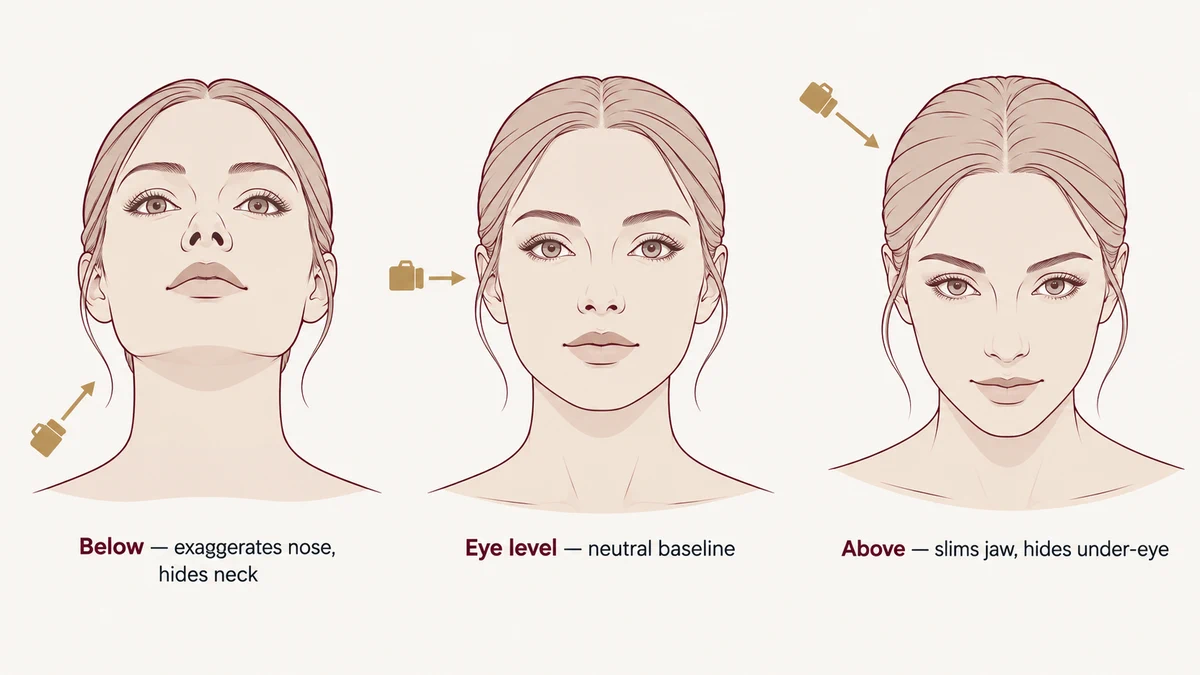
Neck lift galleries are particularly prone to photography-driven distortion because neck contour changes dramatically with head position, lighting angle, and body weight — all of which can shift between a "before" and "after" photo without any deliberate manipulation. Knowing what to look for makes gallery comparison significantly more useful.
Head position and chin angle
This is the single biggest variable in neck photos. A chin-down position in the "before" photo compresses the neck, accentuates submental fat and banding, and makes the jawline look undefined. A chin-up, slightly extended position in the "after" photo stretches the neck skin taut and creates a sharper cervicomental angle even without surgery. A meaningful comparison requires both photos taken at the same neutral head position — ideally with the chin parallel to the floor.
Camera angle
A slightly downward camera angle (photographing from above) in the "after" photo hides the neck and emphasizes the jawline, while a level or upward camera angle reveals the full neck and any remaining laxity. Galleries that change the camera height between "before" and "after" are not providing an apples-to-apples comparison.
Lighting and shadows
Side-angled lighting in the "before" photo creates shadows that emphasize jowling, neck bands, and skin folds. Flat, even lighting in the "after" photo minimizes those same features. The neck's three-dimensional contour is especially sensitive to light direction — more so than flatter areas of the face. Look for consistent lighting setup in both frames.
Weight change between photos
Even 5–10 pounds of weight loss between the "before" and "after" photos can visibly slim the jawline and reduce submental fullness, creating improvement that isn't entirely surgical. Galleries don't typically control for patient weight, and some results include weight loss alongside the surgery. This doesn't invalidate the result, but it means the surgical contribution alone may be less dramatic than the photos suggest.
What neck lift photos rarely show
- The neck in motion: A static profile photo shows the best possible angle. How the neck looks during conversation, turning, or looking down is a different picture. Ask your surgeon about expected range-of-motion appearance.
- Scar placement in detail: Retroauricular scars are hidden from front-facing photos. If concealing scars with short hair or hairstyles pulled back matters to you, ask for close-up scar photos from behind the ear at 6+ months.
- Results at 5+ years: Most gallery photos show the result within the first 1–2 years. Longer-term photos revealing how the result has held up with continued aging are rare but most informative for managing expectations about longevity.
- Concurrent procedures: A "neck lift" result that also included a facelift, chin implant, or liposuction will look more dramatic than a neck lift alone. Always check whether the gallery photo represents a standalone neck lift or a combined procedure.
The most honest galleries show the same lighting rig, head position, and camera angle in both frames, with the time interval clearly stated. When evaluating, focus on patients whose starting condition — skin quality, age range, and degree of laxity — most closely matches yours.
Frequently Asked Questions
Is a neck lift the same as a facelift?
No — a neck lift specifically addresses loose neck skin and platysmal banding, while a facelift focuses on the mid and lower face. The two are often performed together when jowls and neck laxity occur at the same time, but each targets a distinct anatomical area.
Will loose skin come back?
The excess skin removed during surgery does not return, but the neck continues to age naturally afterward, and ongoing gravity, sun exposure, and weight change can gradually reintroduce some looseness over many years. Good skin quality and stable weight tend to preserve results longer.
How long is recovery?
Most visible swelling and bruising resolve within about 2 to 3 weeks, with many patients returning to non-strenuous activity around 1 to 2 weeks. The fully settled contour, once residual swelling and tissue tightening complete, is typically visible by 3 to 6 months.
What does a neck lift actually treat?
A neck lift addresses loose or sagging neck skin, vertical muscle bands (platysmal bands) that create a "turkey neck" appearance, and a poorly defined jawline caused by soft tissue laxity. It's a distinct procedure from liposuction, which only removes fat rather than tightening skin and muscle.
Where are neck lift scars located?
Scars are typically placed behind and below the ears, and sometimes under the chin, positioned to be as inconspicuous as possible within natural creases and behind the hairline. They generally fade significantly over the first year but remain permanent, if faint.
Can neck liposuction alone fix my neck?
Only if excess fat is your primary concern and your skin still has good elasticity to retract afterward. If loose skin or muscle banding is present, liposuction alone typically won't resolve it, and a full neck lift is usually the more appropriate procedure — see our neck lift overview.