
Brow lift before and after searches frequently overlap with eyelid surgery searches, and that overlap isn't a coincidence — the two concerns are genuinely easy to confuse in the mirror. A brow lift raises a sagging brow that can hood the upper eyelids, while blepharoplasty operates on eyelid tissue itself.1 Before comparing your own face to a gallery photo, it is worth understanding precisely what a brow lift changes, what it does not, and how planning helps avoid an overcorrected result.
What a Brow Lift Repositions
A brow lift raises and repositions the eyebrows toward a more youthful anatomical position, and simultaneously softens the horizontal lines and vertical furrows (glabellar lines, the "11s") that develop across the forehead with age. The target of the surgery is the brow itself — the tissues above the orbital rim that have descended due to progressive laxity of the forehead skin, muscle weakening, and gravitational descent over time.
In a younger face, the eyebrow typically sits at or slightly above the orbital rim, with the medial (inner) end roughly level with the outer corner of the nose and the lateral (outer) tail curving slightly upward. With age, the entire brow tends to descend, with the lateral tail often dropping most noticeably, creating a heaviness across the upper face that makes the eyes look tired or stern even when relaxed.
What a brow lift does not address: excess skin on the upper eyelid itself, fine lines in the lid skin, under-eye hollowing or bags, or the ptosis (drooping) of the eyelid margin itself. These are distinct anatomical problems that may coexist with a low brow position — and are frequently confused with it — which is why brow lift consultations ideally involve an examination of all these structures rather than the brow alone.
Recovery from a brow lift typically involves 1–2 weeks of swelling and bruising, with most patients presentable for social situations by 10–14 days. The final refined result, where all swelling has settled and the repositioned tissues have fully consolidated, is generally visible at 2–3 months.
Brow Lift vs Upper Blepharoplasty — Common Confusion
This is the single most important distinction on this page. A low, heavy brow can visually mimic upper eyelid hooding, leading patients — and sometimes less experienced surgeons — to request or recommend eyelid surgery when a brow lift, or both procedures together, would actually address the anatomical root cause.
The mechanism matters: if the brow itself has descended below the orbital rim, it pushes tissue down into the upper eyelid space, creating the appearance of skin excess on the eyelid. Removing upper eyelid skin in this scenario gives a temporary improvement, but the descended brow continues to push downward. The result, without brow repositioning, may look worse faster than expected. Peer-reviewed data on upper blepharoplasty outcomes show significant functional and visual improvements when the right surgical target is selected — the improvement requires correctly identifying what's driving the heaviness.3
| Feature | Brow Lift | Upper Blepharoplasty |
|---|---|---|
| What it targets | Eyebrow descent, forehead lines | Excess upper eyelid skin |
| Incision location | Within or behind hairline (varies by technique) | Within the upper eyelid crease |
| Brow position | Raised and repositioned | Unchanged |
| Visual field improvement | Indirect (via brow elevation) | Direct when skin is obstructing4 |
| Often combined? | Yes, frequently with upper blepharoplasty | Yes, frequently with brow lift |
A thorough exam that specifically measures brow position relative to the orbital rim — not just eyelid skin excess — is essential before choosing between the two. Many patients benefit from both. See our blepharoplasty before and after guide for how eyelid surgery results differ and what the two procedures address respectively.
Techniques & How Results Differ
The technique a surgeon recommends is driven primarily by the degree of brow descent, the patient's hairline, and the extent of forehead correction needed. The three main approaches differ in incision length, correction scope, and recovery:
Endoscopic brow lift: Uses 3–5 small (1–2 cm) incisions placed within the hairline, with a tiny camera (endoscope) providing visualization. Tissue is released and repositioned with internal fixation. Recovery is faster than coronal, scarring is minimal, and this technique is appropriate for mild-to-moderate brow descent in patients with a standard hairline. It may provide less correction for more significant ptosis.
Temporal (lateral) brow lift: A more limited approach targeting the outer third of the brow — the area that droops most notably with age. Incisions are placed in the temple area within the hairline. It's a good option for patients whose primary concern is lateral brow heaviness rather than the full forehead, with a shorter recovery and scar. It doesn't address glabellar lines or full-forehead laxity.
Coronal brow lift: A longer incision running across the top of the scalp, typically within the hair. Provides the most significant and durable correction for advanced brow ptosis, including smoother forehead lines, but carries the longest scar, highest risk of temporary scalp numbness, and in some patients, a risk of hairline elevation that can look unnatural. Generally reserved for patients with more significant descent who won't benefit adequately from the less invasive options.
The right technique is determined by your anatomy — there's no universally "best" method. A surgeon experienced in all three approaches can select based on your specific brow descent pattern, hairline position, and goals.
The "Surprised Look" Concern — Why Over-Elevation Happens
The exaggerated, permanently startled expression sometimes associated with older brow lift results is not an inherent feature of the procedure — it's an outcome of specific surgical planning and technique choices. Understanding why it happens is useful both for setting expectations and for evaluating whether a potential surgeon's approach avoids it.
Over-elevation happens when: (1) the brow is raised uniformly and symmetrically without accounting for the patient's natural resting arch shape, (2) the medial (inner) brow is elevated as much as the lateral brow, creating an arched, surprised look rather than the natural arc where the inner brow stays lower, or (3) the surgeon aims for a dramatically visible "lift" rather than a subtly refreshed position. Historically, the coronal technique at excessive tension was the most common source of the over-elevated look; more conservative tissue handling and endoscopic techniques have reduced this.
What a well-planned result looks like: the lateral brow is elevated toward its natural position — at or slightly above the orbital rim — while the medial brow remains relatively horizontal, preserving a natural arc. The forehead is smoother but not pulled. The overall impression is "rested" rather than "operated on." Reviewing a surgeon's gallery specifically for this balance, in relaxed neutral-expression photos (not smiling), is a useful part of the evaluation process.
Reading Photos Critically
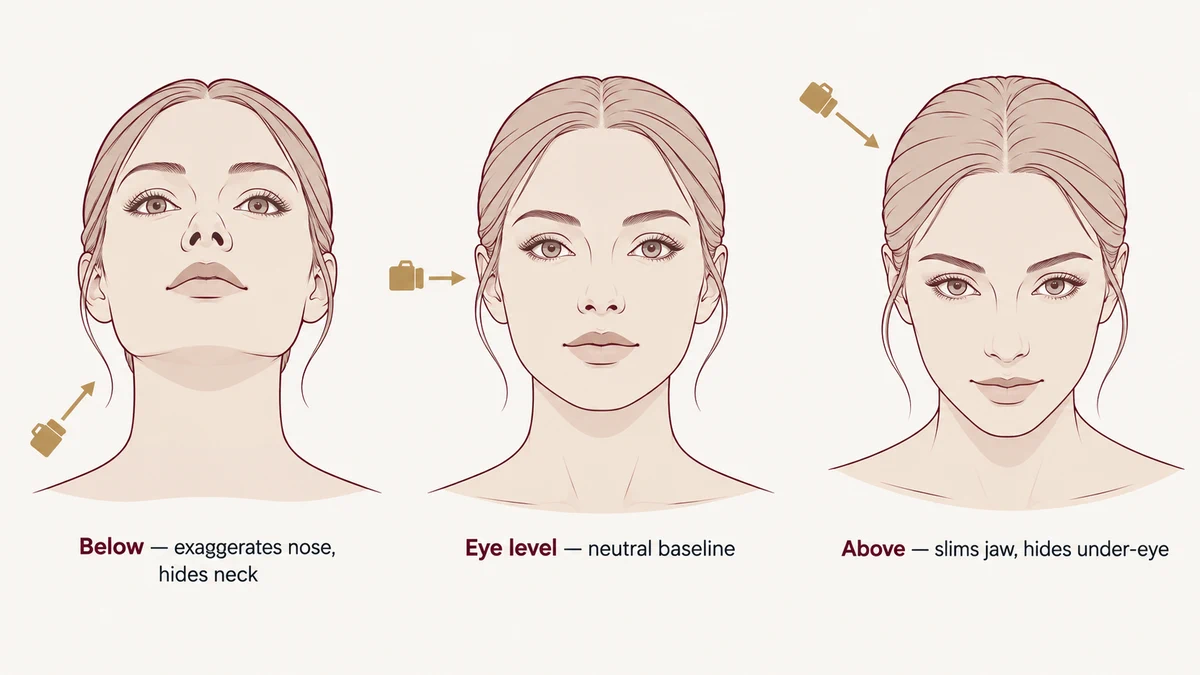
Gallery photos for brow lift results require more critical analysis than most patients apply. The brow's position changes visibly with expression, lighting, and camera angle — meaning photographic variables can either exaggerate or understate the surgical result. Here's what to evaluate:
Expression in the photo
Is the "after" photo taken with a fully relaxed, neutral expression, or is the patient slightly raising their brows — consciously or not — which would artificially improve the apparent result? The frontalis muscle can lift the brow 3–5 mm voluntarily, which is a significant fraction of what a surgical lift achieves. A genuinely neutral resting expression is the only fair comparison.
Medial vs lateral brow position
Look at the inner corner of the brow. If it's dramatically elevated relative to the outer corner, the arch may look unnatural in daily expression. A well-planned lift raises the lateral brow more than the medial, preserving the natural slope rather than creating a uniform arch that reads as "surprised."
Symmetry
Minor asymmetry is normal and common — most faces have some baseline brow asymmetry before surgery. Significant new asymmetry in the "after" photo warrants questions about the surgeon's planning process. Look specifically at whether both brows are elevated equally relative to their starting positions, not just whether they're at the same absolute height.
Lighting and angle
Overhead lighting and a slightly upward camera angle both make brows look more elevated than they appear at eye level in daily life. Conversely, flat front-facing light can minimize the apparent lift. Consistent lighting and angles between before and after are a quality signal — different setups make the comparison unreliable.
Time since surgery
Photos taken at 6 weeks post-op may show more swelling-related elevation than the final settled result at 3+ months. Ask the surgeon how old their gallery photos are. The most useful galleries state the exact time interval and show the same patient at multiple post-operative stages.
What brow lift photos rarely show
- Hairline position change: Coronal and some endoscopic techniques can slightly raise the hairline, which may be visible in side-by-side comparison but is often cropped out of photos. If forehead height matters to you, ask specifically about this.
- Scar visibility: Endoscopic and temporal incisions are generally well-hidden within the hairline, but patients with thin hair or who wear their hair pulled back may notice them. Close-up hairline photos are rare in galleries.
- Combined procedures: A "brow lift" result that also included upper blepharoplasty will show more dramatic periorbital rejuvenation than a brow lift alone. Check whether the gallery photo represents a standalone procedure.
- How it looks while talking or laughing: Brow dynamics — how the brow moves during expression — are not captured in a static photo. Over-elevated results often look acceptable at rest but strained during animation.
A well-organized gallery should state when each photograph was taken and include a range of ages and starting brow positions, not just the most dramatic cases. Ask to see mature results rather than relying on an unlabeled early postoperative image.
Longevity & Botox as an Alternative
Surgical brow lift results are considerably more durable than non-surgical options. Published longevity estimates for endoscopic and coronal brow lifts typically cite 5–10+ years before meaningful further descent, though individual results vary with skin quality, age at surgery, and post-surgical skin care. The forehead continues to age naturally after surgery, meaning some degree of re-descent is expected over time — but from a higher, more youthful starting position.
Botox for brow lifting works by relaxing the depressor muscles (primarily the orbicularis and corrugator) that actively pull the brow downward, allowing the frontalis — the forehead muscle that elevates the brow — to work with less opposition. The result is a modest, temporary brow elevation of 1–3 mm in most patients, lasting 3–4 months per treatment. This is a reasonable option for patients with only mild brow descent who aren't ready for surgery, those wanting a preview of a lifted brow position before committing, or those seeking to maintain a surgical result.
Botox does not address skin laxity, forehead creasing from tissue descent, or moderate-to-significant brow ptosis. Patients whose brow has descended substantially — where the tail sits visibly at or below the orbital rim — typically see limited functional improvement from Botox alone. The choice between non-surgical and surgical correction is worth discussing with a surgeon who performs both, to get an unbiased recommendation based on your degree of descent.
Frequently Asked Questions
Do I need a brow lift or eyelid surgery?
It depends on where the actual problem sits: if your eyebrows themselves have dropped low, a brow lift repositions them, while if the issue is excess skin on the upper eyelid itself, blepharoplasty is the appropriate fix. Many patients need only one, but a careful exam is the only reliable way to tell which — some benefit from both.
Will I look surprised?
That "surprised" look results from over-elevating the brows beyond a natural position, which is a technique and planning issue rather than an inevitable outcome. A surgeon experienced in brow lifting aims for a natural, mildly refreshed arch rather than a dramatically raised one.
How long does a brow lift last?
Surgical brow lift results are generally long-lasting, often 5 to 10 years or more, though the forehead and brow continue to age naturally afterward. This is considerably longer than temporary alternatives like Botox, which typically last only a few months per treatment.
What's the difference between a brow lift and Botox?
Botox temporarily relaxes muscles that pull the brow down, offering a modest, non-surgical lift that lasts a few months, while a surgical brow lift physically repositions the brow tissue for a longer-lasting change. Botox is a reasonable option for milder concerns or those not ready for surgery.
How is a brow lift performed?
Techniques include endoscopic (small hidden incisions with camera guidance), temporal (limited to the outer brow), and coronal (a longer incision across the scalp) approaches, chosen based on the degree of correction needed and hairline considerations. Your surgeon will recommend the technique suited to your anatomy and goals.
Can a brow lift be combined with other facial procedures?
Yes, a brow lift is commonly performed alongside upper blepharoplasty or as part of a broader facial rejuvenation plan, since brow and eyelid concerns often overlap. Combining procedures can mean a single recovery period instead of two separate ones.