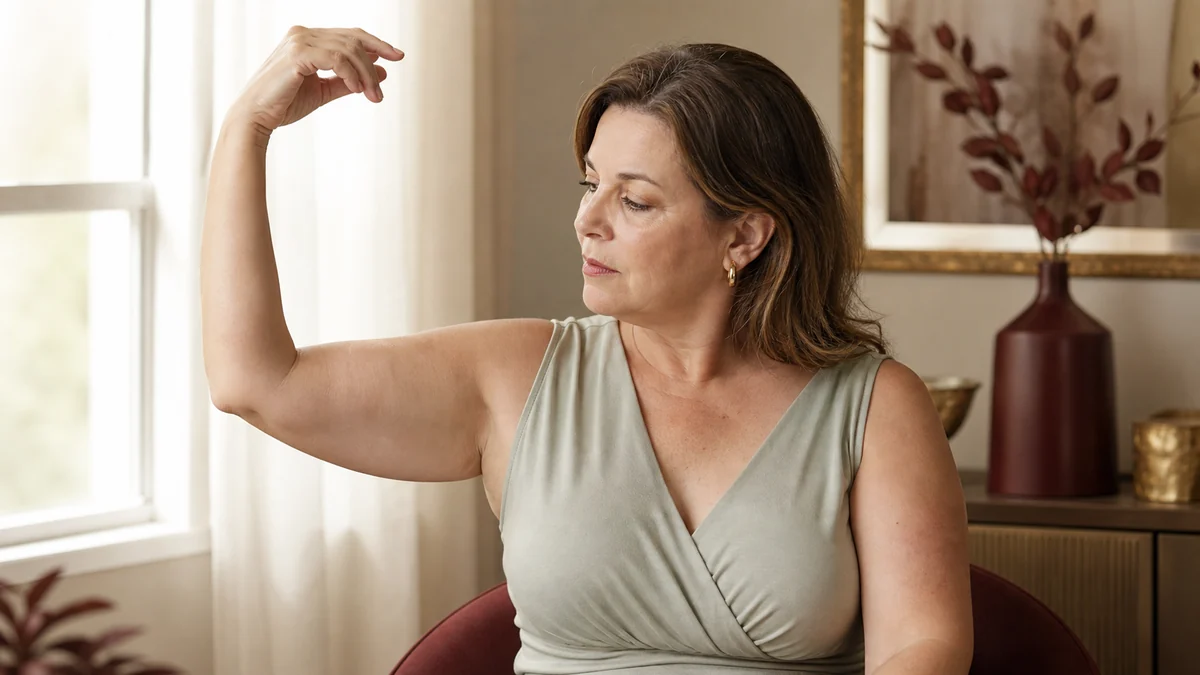
Arm lift — medically called brachioplasty — is one of the most straightforward body-contouring procedures to understand and one of the hardest to decide on emotionally, because the benefit (removing hanging upper-arm skin) comes with a cost you carry permanently: a long scar along the inner arm. This page covers the full procedure overview — what it is, who it suits, how recovery works, and what results realistically look like — while treating the scar trade-off as a first-class topic rather than a footnote. For the combined arm-and-thigh perspective, see our dedicated arm lift & thigh lift guide.
What Is an Arm Lift?
A brachioplasty removes excess skin (and sometimes a modest amount of fat) from the upper arm through an incision placed along the inner arm, typically running from near the armpit toward the elbow. The goal is to eliminate the "bat wing" or hanging skin that remains after significant weight loss, aging-related skin laxity, or genetics — skin that exercise and weight management alone cannot tighten because the problem is structural, not muscular.
Arm lift is fundamentally different from liposuction. Liposuction removes fat but does not remove skin; if skin elasticity is poor, removing fat alone can leave the arm looking deflated or still crepey. Brachioplasty excises the redundant skin envelope and redrapes what remains, producing a tighter contour at the price of a visible scar. ASPS describes brachioplasty as addressing excess skin that has lost elasticity, most commonly in patients who have lost a substantial amount of weight.1
Technique variations exist. A standard brachioplasty uses the full inner-arm incision when significant skin excess extends toward the elbow. A limited or "mini" brachioplasty may confine the scar more to the armpit when excess is milder and concentrated higher on the arm — trading less scar length for less dramatic tightening. Liposuction may be combined when excess fat contributes alongside loose skin. Your surgeon selects the approach based on how much skin needs to be removed and where the excess is concentrated.
Am I a Candidate?
Good candidates have noticeable, loose, or hanging skin on the upper arm that does not respond to exercise or further weight loss, are in stable general health for surgery under general anesthesia, and have realistic expectations about both contour improvement and the permanent inner-arm scar. Non-smokers heal more predictably; active smokers are typically asked to stop for a defined period before and after surgery because nicotine impairs wound healing along a long incision.
Weight stability matters. Most surgeons prefer to see a stable weight for at least several months — often a year — before body-contouring surgery, since significant weight regain or loss afterward can change the skin envelope and undermine the result. Post-bariatric patients are among the most common candidates, often pursuing arm lift as part of a staged body-contouring plan after massive weight loss.
If the primary concern is fat rather than skin, liposuction alone may be sufficient when skin elasticity remains reasonably good. See our full guide's liposuction-alone section for how surgeons assess this on exam — the pinch test, skin recoil, and where hanging versus fullness is located all factor in. Patients with active infection, uncontrolled medical conditions, or unrealistic expectations about scar invisibility may not be suitable candidates.
Age alone is not a disqualifier, but skin quality, surgical history, and healing capacity all factor in. Prior arm surgery or radiation can affect candidacy. A thorough consultation should include a physical assessment of skin excess, a discussion of scar placement options, and explicit confirmation of what the scar will look like at various healing stages — not just immediately post-op.
The Procedure & Anesthesia
Brachioplasty is performed under general anesthesia in an accredited surgical facility, with continuous monitoring by a qualified anesthesia provider. Total operating time typically runs two to three hours depending on whether one or both arms are treated, how much skin is excised, and whether liposuction is combined.
The surgical sequence generally follows a consistent pattern. First, the surgeon marks the planned incision along the inner arm while you are standing, since skin laxity appears differently with gravity than when lying down. An elliptical wedge of excess skin (and sometimes fat) is removed, and the remaining skin edges are brought together and closed in layers — deeper sutures for strength, surface sutures or staples for the skin. Drains are sometimes placed temporarily if a large dead space exists, though not every surgeon uses them routinely.
Scar placement is deliberate: the inner arm is chosen because it is less visible in a natural arm-at-side posture than the outer arm would be, though the scar is still genuinely visible when arms are raised, in short sleeves, or on close inspection. Some surgeons taper the incision into the axilla (armpit) to shorten visible scar length when anatomy allows. Compression garments are applied at the end of surgery to support healing and reduce swelling.
Recovery Timeline
Arm lift recovery is driven by incision length and the tension created when skin is pulled tight — arm movement stretches the healing wound, which is why activity restrictions last longer than for many smaller cosmetic procedures.
Days 1–3: Expect soreness, swelling, and bruising along the inner arms. Pain is typically managed with oral medication. Arms are kept in a slightly flexed, protected position; raising arms overhead is avoided. Drain care, if applicable, follows surgeon protocol. Short walks are encouraged to reduce clot risk.
Days 4–14: Swelling peaks early in this window then begins to decline. Most patients can manage light daily activities within the first week but should avoid lifting, pushing, or reaching overhead. Desk-based work may resume around days 10 to 14 for some patients, though arm-dependent jobs take longer. Compression garments continue per protocol.
Weeks 3–8: Gradual return to normal arm use, with heavy lifting and strenuous exercise typically deferred until weeks 6 to 8 or later. Scar care — silicone sheeting, massage, sun protection — often begins once incisions are fully closed. See our broader post-surgery warning signs guide for symptoms that warrant urgent contact versus normal healing.
Months 3–12: Swelling continues to subside and scar maturation progresses. The scar typically appears pink or raised early on, then fades and flattens over 12 to 24 months. Evidence for silicone gel sheeting in scar management shows modest benefit for hypertrophic and keloid scars, though results vary individually.4 Final contour is usually visible by three to six months once swelling resolves.
Results & Scar Maturation
The primary result is tighter upper-arm contour without hanging skin — a change that many post-weight-loss patients describe as freeing them to wear short sleeves without self-consciousness. The trade-off is permanent: the inner-arm scar does not disappear, though it typically improves substantially in color and texture over the first one to two years.
Setting expectations before surgery prevents disappointment. Photos at six weeks are not representative of long-term scar appearance. Asymmetry can occur if healing differs side to side or if pre-existing asymmetry was not fully accounted for in planning. Weight fluctuations after surgery affect remaining soft tissue — significant weight gain can stretch results; further weight loss can create new laxity in untreated areas.
Patients who cannot accept a long, visible scar should not proceed with standard brachioplasty — a limited incision approach or non-surgical alternatives may be discussed, but each carries its own limitations. Our arm lift & thigh lift guide walks through the scar-versus-benefit decision in more depth, including what scars look like at different healing stages.
Risks & Complications
General surgical risks include infection, bleeding, hematoma, wound separation, asymmetry, and unfavorable scarring (hypertrophic or keloid scars, which are more common in certain skin types and anatomical locations). Arm-lift-specific risks include seroma (fluid collection under the skin), prolonged numbness along the inner arm, and tightness that limits full extension until tissues relax.
Large abdominoplasty data sets associate concurrent procedures and longer operative time with higher complication risk.3 That study does not provide an arm-lift-specific risk estimate, so it should support — not replace — individualized discussion about whether combining an arm lift with a thigh lift or other contouring is appropriate for your health profile.
Choosing a board-certified plastic surgeon who operates in an accredited facility addresses many of the most serious risk factors. Sudden shortness of breath, chest pain, or signs of infection (spreading redness, fever, purulent drainage) warrant prompt medical attention. Our guide on verifying a surgeon's credentials explains how to confirm board certification before booking.
Cost
Arm lift in the US typically costs $5,500 to $9,000 total, including surgeon's fee, anesthesia, and facility fee. Bilateral (both arms) treatment, combined liposuction, and high-cost metro areas push toward the upper end. The quote should itemize what is included — garments, follow-up visits, and revision policies vary by practice.
Because arm lift is almost always cosmetic, insurance rarely covers it. Comparing quotes to liposuction alone is not apples-to-apples — brachioplasty includes skin excision and a much longer incision. An unusually low price that omits accredited facility fees or qualified anesthesia is a warning sign on any surgical procedure. See our cost guide for how arm lift pricing compares across procedures on this site, and our financing guide if payment planning is part of your research.
Frequently Asked Questions
Who is a good candidate for an arm lift?
Good candidates have noticeable, loose, hanging skin on the upper arm that doesn't respond to exercise, most often after significant weight loss. See our full arm lift and thigh lift guide for how this is distinguished from cases where liposuction alone might suffice.
Is the arm lift scar really that visible?
Yes — it's a genuine, long, permanent scar along the inner arm, though it fades and flattens considerably over 12 to 24 months. Our full guide covers this trade-off in detail before you decide.
How much does an arm lift cost?
In the US, arm lift typically costs $5,500 to $9,000 total. See our cost guide for current typical figures across body-contouring procedures.
Can arm lift be combined with other procedures?
Yes — it's sometimes combined with thigh lift or other body-contouring procedures in post-weight-loss patients, though this increases total surgery and recovery time. See our full guide for more on combination planning.
How long is arm lift recovery?
Most patients return to desk work within 2 to 3 weeks, with heavier activity restricted until 6 to 8 weeks. Full scar maturation continues for 12 to 24 months.
Will insurance cover an arm lift?
Arm lift is almost always classified as cosmetic. See our insurance coverage guide for general documentation criteria in rare reconstructive scenarios.