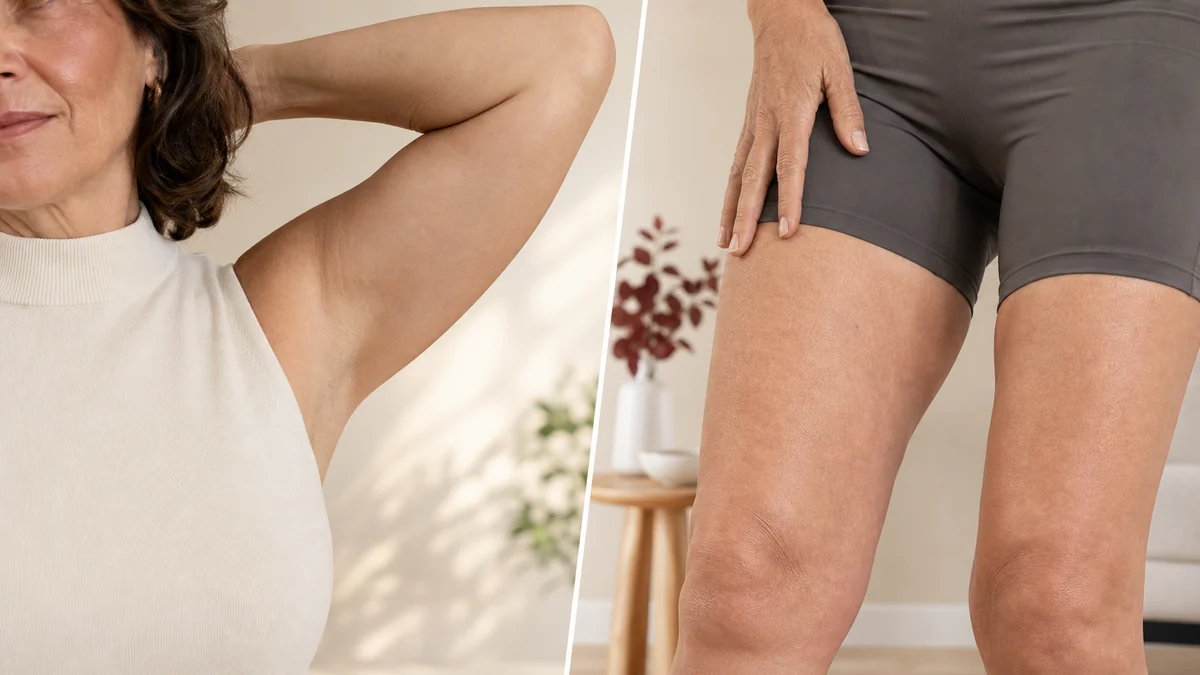
Arm lift (brachioplasty) and thigh lift (thighplasty) are grouped together here because they share the same core trade-off: both remove genuinely excess, hanging skin — most commonly after major weight loss — at the cost of a long, permanent, visible scar. Both are increasingly performed in the US as bariatric surgery rates have grown.1
Who These Procedures Are For
The best candidates share a specific profile: noticeable, loose, hanging skin that doesn't respond to exercise or weight management, with weight stable for several months to a year. The most common context is significant weight loss — bariatric surgery or sustained lifestyle change — where fat loss outpaces the skin's ability to retract. Age-related skin laxity is a secondary but real context, without major weight loss.
The defining candidacy criterion is excess skin, not primarily excess fat — this determines whether a lift is actually necessary or whether liposuction alone might suffice (covered below). Patients still in an active bariatric weight-loss phase are typically advised to wait until weight and nutrition have stabilized, since surgery on metabolically stressed tissue carries higher wound-healing risk.
The Scar Trade-Off
This is the part of the conversation that most often gets underemphasized — and where most post-surgical regret originates. Both scars are long by design, since the incision must span the length of skin removed; there is no short or hidden-scar version when a significant amount is excised. Scar care can help — silicone sheeting and gel have the most evidence behind them — but the scar will remain visible.2 Patients who accept this in advance report the highest satisfaction; those who underestimate it tend to have the most regret.
Arm Lift Scar Placement
Arm lift incisions typically run along the inner arm, from near the axilla (armpit) toward the elbow — a short-scar or mini arm lift uses a smaller incision in the axilla for minimal excess, while a standard incision extends further down the inner arm for more significant excess. This placement is chosen because it's the most concealed position available: largely hidden with the arm at the side, more visible when raised or in short sleeves. The scar is typically pink and raised for three to six months, then gradually flattens and lightens over the following 12 to 18 months; it never fully disappears.
Thigh Lift Scar Placement
Thigh lift scars vary more depending on technique. An inner (medial) thigh lift with a horizontal incision places the scar along the groin crease, hiding it in a natural fold — the best concealment option, suited to upper inner-thigh excess. For skin excess extending further down, a vertical incision along the inner thigh is added, more visible when seated or with legs together. The inner thigh sees more friction from walking than arm scars, so soft compression garments are typically advised during healing.
When Liposuction Alone Is Enough
If a patient's primary concern is excess fat volume rather than loose skin, and skin elasticity is still reasonably good, liposuction alone may achieve an acceptable result without the longer scar of a skin-excision lift. Liposuction removes fat but not skin — it relies on the skin retracting after fat removal, which requires meaningful elasticity. This is a physical exam assessment, not patient preference: a surgeon checks how skin responds to pinching and the "snap-back" test. Skin that redrapes poorly during examination is unlikely to redrape well after fat removal.
In patients with borderline elasticity, surgeons sometimes discuss energy-assisted devices (radiofrequency or laser-assisted liposuction) that add skin-tightening energy alongside fat removal — evidence for meaningful tightening is limited and variable, and these shouldn't be marketed as a substitute for a skin-excision lift when significant excess skin is the primary issue.
Recovery & Activity Restrictions
Recovery is longer and more restricted than patients often anticipate, because the incisions sit under constant tension from ordinary movement — raising an arm or walking stretches the healing incision directly. Most patients need 2 to 3 weeks before returning to desk work; lifting, overhead reaching, or leg movement are typically restricted for 6 to 8 weeks or longer, with exercise beyond light walking off the table for 4 to 6 weeks.
Compression garments are worn continuously in the early weeks to reduce swelling — especially for thigh lift, since the inner thigh is prone to swelling from its location. Drains are sometimes placed for arm lift and more commonly for thigh lift, typically removed within one to two weeks. Full scar maturation takes 12 to 24 months, and the trajectory isn't linear.
Recovery planning should reflect which limb is being treated. After an arm lift, reaching overhead, carrying groceries, and pushing up from a chair may be temporarily difficult. After a thigh lift, stairs, getting into a car, and friction at the groin crease can be the bigger challenges. Arranging help with meals, transport, children, and pets before surgery reduces avoidable tension on a fresh incision during the period when wound protection matters most.
Realistic Results
Results are generally excellent at achieving the core goal: removing excess, hanging skin and creating a smoother, more contoured limb profile. In appropriately selected patients, these procedures produce high satisfaction precisely because the hanging skin causing clothing-fit and comfort problems is genuinely resolved. The strongest predictor of satisfaction is honest, dual-sided expectations — the smoother result, and the long, visible scar. Patients who focus only on the former are most likely to experience regret.
A lift changes the skin envelope; it does not create muscle definition, eliminate every contour irregularity, or guarantee perfect symmetry. Small differences between sides may remain, and the final contour continues to settle as swelling resolves. Stable weight helps protect the result: substantial future weight loss can create new laxity, while weight gain can change the proportions around the treated area even though the removed skin itself does not return.
| Arm Lift (Brachioplasty) | Thigh Lift (Thighplasty) | |
|---|---|---|
| Target area | Upper arm, inner surface | Inner and/or outer thigh |
| Scar location | Inner arm, armpit to near elbow | Groin crease ± vertical inner thigh |
| Surgery time | 1.5–2.5 hours | 2–3.5 hours |
| Return to desk work | 2–3 weeks | 2–3 weeks |
| Full activity | 6–8 weeks | 6–8 weeks |
| Drains common | Sometimes | More commonly |
Cost
Arm lift in the US typically costs $5,000 to $9,000. Thigh lift generally runs higher — often $7,000 to $12,000 — reflecting longer operative time and added complexity. Neither is covered by insurance for cosmetic skin-excess concerns; some insurers evaluate coverage when hanging skin causes documented breakdown or infection, case-by-case. See our cost guide for broader context.
Ask for an itemized quote that separates the surgeon, anesthesia, facility, garments, testing, and follow-up costs. Combining an arm or thigh lift with another body-contouring procedure may change both the total price and the safe amount of surgery that can be completed in one session. A lower initial quote is not a meaningful saving if essential recovery supplies, overnight care, or treatment of a wound problem are excluded.
Frequently Asked Questions
How bad are arm lift scars?
Arm lift scars run along the inner arm from near the armpit to sometimes the elbow, and are long, permanent, and typically raised or pink for the first several months before fading and flattening over one to two years. Most patients weigh the scar as an acceptable trade-off against the excess skin it removes, but it is a genuine, visible scar, not a minor one.
Can I get lipo instead?
Only if your skin still has enough natural elasticity to redrape smoothly after fat is removed — liposuction doesn't remove excess skin, so it won't resolve significant hanging or crepey skin on its own. Your surgeon assesses skin elasticity on exam to determine whether liposuction alone is realistic.
How long is thigh lift recovery?
Most patients need about 2 to 3 weeks before returning to sedentary work, with several more weeks of restricted exercise before resuming normal routines, since thigh lift incisions are under more tension from walking than most other body procedures. Full scar maturation continues for up to two years.
Will the scar ever fully fade?
It will lighten and flatten considerably over 12 to 24 months, but remains permanently visible on close inspection — no scar from this surgery disappears completely. Silicone-based scar care products have the best evidence for supporting maturation.
Can arm lift and thigh lift be combined with other procedures?
Yes, they're sometimes combined with each other or with other body-contouring procedures like abdominoplasty, though combining procedures increases total surgery time and recovery complexity. Your surgeon will advise whether staging separately is safer for your case.
Is weight stability required before surgery?
Most surgeons prefer to see a stable weight for at least six months to a year before surgery, since weight changes afterward can affect the skin envelope and undermine the result. Nutritional stability matters too, particularly post-bariatric surgery.