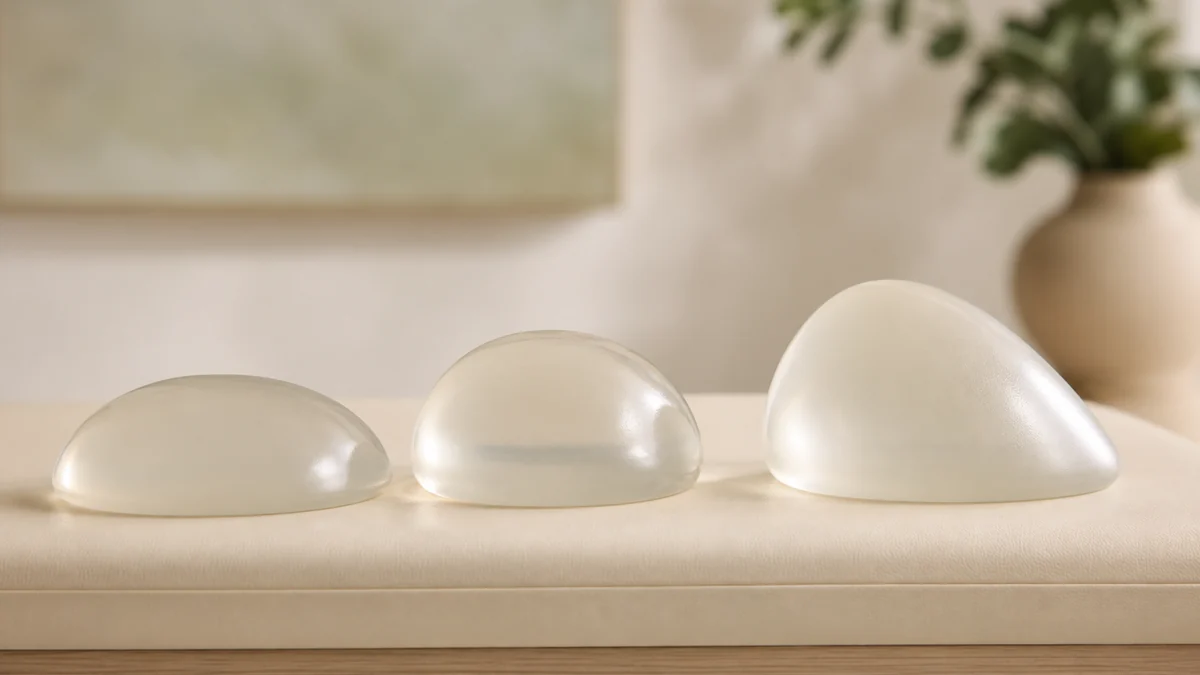
Choosing a breast implant type is one of several decisions in breast augmentation — alongside placement (above or below muscle), incision location, and whether augmentation is combined with a lift. This page focuses specifically on implant fill material, surface characteristics, and sizing logic. For the complete augmentation picture including candidacy, recovery, and cost, see our full breast augmentation guide and our dedicated breast implant types guide.
Implant Types Explained
Silicone gel implants are filled with a cohesive silicone gel and are widely regarded as feeling the most natural, particularly for patients with less native breast tissue covering the implant. The gel moves cohesively rather than flowing like a liquid, which reduces visible rippling in thin-tissue patients compared with saline. If a silicone shell fails, the gel typically remains contained within the scar capsule that forms around the implant — a "silent rupture" detectable on imaging rather than obvious visually.
Saline implants are filled with sterile saltwater after the empty shell is placed surgically, allowing some fill-volume adjustment during the operation. If a saline shell fails, the implant deflates visibly and the body harmlessly absorbs the saline — making failure obvious but generally not medically urgent. Saline implants may feel slightly less natural than silicone, particularly in patients with minimal breast tissue, and rippling can be more visible.
Form-stable implants — often nicknamed "gummy bear" implants for their thicker, highly cohesive gel — hold their shape well under gravity and maintain contour even if the shell is compromised, because the gel does not flow. They tend to feel somewhat firmer than standard silicone gel and require a slightly longer incision for placement due to implant shape. ASPS describes these as an option for patients seeking shape retention and lower traditional leak risk, with trade-offs in feel and incision length.1
Implant surface — smooth versus textured — is a separate decision with safety implications. Textured surfaces were developed to reduce capsular contracture and rotation in certain shaped implants, but are now primarily discussed in the context of BIA-ALCL risk (see Safety section below). Many surgeons today favor smooth implants for routine round augmentation.
Round versus anatomical (teardrop) shape is another fork in the decision tree. Round implants provide fullness in the upper pole when upright and are less rotation-sensitive. Anatomical implants mimic a natural slope but can rotate, creating visible distortion — a risk round implants do not share. Form-stable gummy bear implants are more commonly anatomical, linking shape, feel, and incision length decisions together.
Sizing in cc & Profile
Implant volume is measured in cubic centimeters (cc), not cup size. The same cc volume produces different visual results depending on chest width, existing breast tissue, implant profile, and whether a lift is combined. A 350 cc implant on a narrow chest can look significantly larger than the same volume on a broad chest — which is why cup-size goals translate poorly across patients.
Implant profile describes how far the implant projects forward relative to its base width. Low-profile implants spread width more and project less; high-profile implants project more from a narrower base. Profile selection is matched to chest dimensions and desired shape — a high-profile implant on a wide chest can look unnaturally narrow at the base; a low-profile implant on a narrow chest may not achieve desired projection.
During consultation, surgeons typically use physical sizers (temporary implants placed over the breast in a bra) or 3D imaging to preview approximate results. Starting from a target cup size alone is less reliable than evaluating cc volume in the context of your specific anatomy. See our breast augmentation before-and-after guide for how to read result photos critically when comparing sizes.
Base width — the footprint of the implant on the chest wall — must fit within your natural breast dimensions. An implant too wide for the chest can extend into the armpit or create unnatural cleavage spacing; too narrow may look high and ball-like. Profile then determines projection from that base. These two variables work together, which is why implant selection is a three-dimensional decision, not a cc number alone.
Safety & Long-Term Monitoring
All breast implants require ongoing monitoring — they are not lifetime devices. The FDA recommends screening for silent silicone rupture with MRI or ultrasound starting at five to six years post-surgery and every two to three years thereafter, though individual surgeon protocols vary. FDA labeling recommendations emphasize patient communication about rupture screening, BIA-ALCL, and the distinction between BIA-ALCL and breast implant illness (BII) — two separate concerns that patients often conflate.2
BIA-ALCL (breast implant-associated anaplastic large cell lymphoma) is a rare T-cell lymphoma linked primarily to textured implant surfaces. Consensus guidelines from plastic surgery associations address risk stratification, diagnosis, and treatment, including the recommendation that textured implants are no longer routinely used for cosmetic augmentation in many practices.3 Symptoms such as persistent swelling, fluid collection, or a mass years after implant surgery warrant evaluation.
Breast implant illness (BII) refers to a constellation of systemic symptoms some patients attribute to their implants. The evidence base remains limited and contested — see our dedicated breast implant illness page for what current research does and does not show. BII and BIA-ALCL are distinct entities and should not be conflated in informed consent discussions.
Capsular contracture — firm scar tissue forming around the implant — remains one of the most common reasons for reoperation regardless of implant type. Rupture, malposition, rippling, and size-change requests are other common reasons patients pursue implant removal or exchange.
MRI or ultrasound screening schedules should be discussed at consultation and documented in your medical record — particularly for silicone implants where silent rupture is possible. Patients sometimes assume annual mammograms alone detect implant failure; implant-specific imaging protocols are separate and should be followed per FDA and surgeon guidance.
Choosing the Right Implant
No implant type is universally "best." The decision integrates tissue thickness (silicone often preferred when tissue is thin), desired feel (softer vs firmer), failure-detection preference (visible saline deflation vs imaging-detected silicone rupture), shape goals (round vs anatomical/teardrop), and long-term monitoring willingness.
Anatomical (teardrop) implants can suit patients seeking a natural slope, but rotation of a shaped implant creates visible distortion — a risk that round implants do not share. Fat transfer offers an implant-free alternative for modest volume goals in patients with adequate donor fat — see our fat transfer overview for comparison.
A thorough consultation should include discussion of all implant types available to you, surface options, expected monitoring schedule, and what reoperation rates look like at 10 and 20 years — not just the immediate post-op result. Our guide on verifying surgeon credentials explains how to confirm board certification before booking.
Dual-plane placement — partially submuscular, partially subglandular — is a hybrid approach some surgeons use to balance upper-pole coverage with lower-pole natural shape. Implant type interacts with placement: cohesive gummy bear implants in dual-plane may feel firmer at the muscle interface than standard silicone. These combined decisions are why implant-type research alone is insufficient without a full augmentation consultation.
Lifespan & Replacement
Breast implants are not lifetime devices, but there is no universal rule requiring replacement at 10 years or any other fixed date. Some patients keep implants longer without an identified problem; others require earlier reoperation because of contracture, rupture, malposition, symptoms, or preference change. Planning for monitoring and the possibility of future removal or replacement is part of honest informed consent.
Implant exchange surgery can switch type, size, or surface if desired — for example, from saline to silicone, or from larger to smaller volume — though exchange is a separate procedure with its own recovery and cost. Some patients exchange into a lift when tissue has changed since the original augmentation. Discussing long-term preferences during initial planning can reduce future surprise.
Patients researching implants should also understand placement — submuscular versus subglandular — affects rippling visibility, mammography interpretation, and recovery. Implant type and placement are interdependent decisions covered on our breast augmentation page, not on this implant-types page alone.
ASPS annual statistics show breast augmentation among the most commonly performed cosmetic procedures in the United States; those volume figures should not be interpreted as reoperation-rate data.4
Cost
Implant type affects total augmentation cost modestly compared with surgeon, facility, and anesthesia fees. US breast augmentation typically runs $6,000 to $12,000 total depending on geography, implant selection, and whether a lift is combined. Form-stable and anatomical implants may carry a higher device cost than standard round saline or silicone.
Quotes should itemize surgeon fee, anesthesia, facility, implant cost, and follow-up. Unusually low prices that omit accredited facility fees are a warning sign. See our cost guide for procedure comparisons and our financing guide for payment options.
When comparing implant types in our dedicated guide with this overview, use both resources together: this page explains the decision framework; the guide walks through specific product categories and sizing scenarios in more detail. Neither page replaces an in-person consultation with physical sizers.
Frequently Asked Questions
Silicone or saline — which is better?
Neither is universally better — silicone gel generally feels softer and more natural, while saline implants can be adjusted for fill volume during surgery and typically show a visible, contained deflation if the shell fails. The right choice depends on your priorities and your surgeon's specific recommendation for your anatomy.
What are "gummy bear" implants?
"Gummy bear" is a common nickname for form-stable, highly cohesive silicone gel implants that hold their shape well and are less likely to leak in the traditional sense if the shell is compromised. They tend to feel slightly firmer than standard silicone gel implants.
How is implant size measured?
Volume is measured in cc, not cup size. See our full breast augmentation procedure page and implant types guide for how sizing decisions are made using cc volume and in-person sizers.
Do all implant types have the same lifespan?
No breast implant is considered a lifetime device, but there is no universal replacement date. Some patients need earlier reoperation for rupture, contracture, malposition, or preference change, while others keep implants longer without a problem. Regular monitoring and follow-up are part of long-term implant care.
What is BIA-ALCL?
BIA-ALCL is a rare lymphoma linked primarily to textured implant surfaces. See our breast implant illness page for how BIA-ALCL differs from BII — they are distinct concerns.
Can I switch implant types later?
Yes — implant exchange surgery can switch from one type to another if desired, though this is a separate procedure with its own recovery. Discuss your long-term preferences with your surgeon during initial planning to minimize future exchanges.