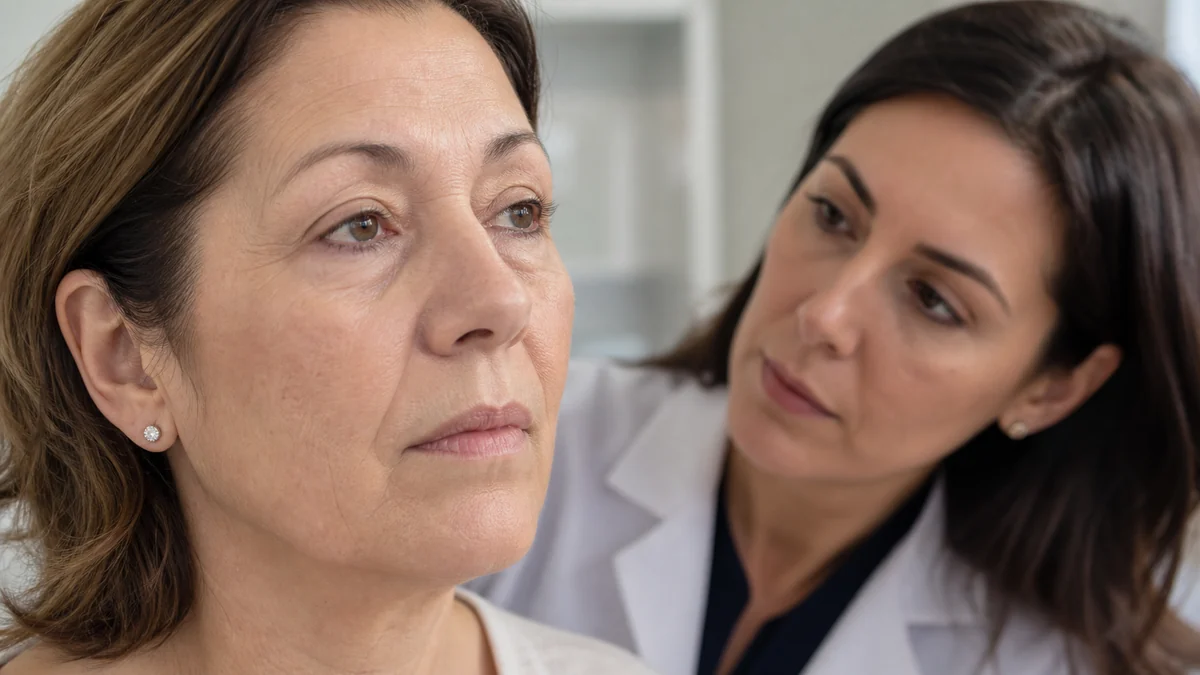
Upper blepharoplasty is the more commonly medically-relevant of the two eyelid procedures, because heavy or drooping upper eyelid skin can genuinely interfere with vision in a way that lower eyelid changes never do — and it remains one of the most frequently performed facial procedures in ASPS annual statistics.3 This page focuses specifically on the upper eyelid: what it corrects, how a surgeon decides whether a case is cosmetic or functional, recovery expectations, and links to our eyelid surgery recovery guide, cost guide, and lower blepharoplasty overview when under-eye bags accompany upper lid hooding.
What Upper Eyelid Surgery Corrects
Upper blepharoplasty addresses dermatochalasis — excess, lax skin that folds and drapes over the natural eyelid crease — along with, in some cases, a small pad of fat that bulges near the inner corner of the eye. As this skin accumulates over years, it can create a heavy, tired appearance and, when significant, physically rest on the eyelashes or fold down far enough to block the upper field of vision. It's important to note that upper blepharoplasty treats skin and fat only — it does not correct ptosis, a separate condition where the eyelid margin itself sits too low due to a weakened levator muscle. If ptosis is present, it requires a different surgical repair, sometimes performed alongside blepharoplasty. See our full comparison of ptosis vs dermatochalasis for how to tell which one you have.
Asian upper eyelid anatomy sometimes includes a absent or partial crease — a different surgical goal from aging-related dermatochalasis. Crease formation surgery (double eyelid surgery) is a related but distinct procedure from standard upper blepharoplasty for excess skin in aging patients. If your primary concern is crease creation rather than skin removal, discuss this explicitly during consultation.
Is It Cosmetic or Functional?
This is the central question for upper eyelid surgery, and it determines whether insurance coverage is even a possibility. A case is generally classified as functional when standardized visual field testing demonstrates that the excess skin obstructs a defined percentage of the superior visual field, combined with clinical photographs showing the obstruction and, often, documentation that the eyelid skin rests on the eyelashes. A systematic review of the functional-outcomes literature found that patients undergoing upper blepharoplasty on these grounds experienced measurable improvements in visual field, reduced headache frequency (often related to compensatory brow-raising), and better quality-of-life scores.2 A separate study using formal Goldmann visual field testing before and after surgery recorded an average nearly five-fold improvement in the superior field.1 Without this kind of documented, measurable obstruction, the procedure is classified as cosmetic and is not covered. For the full procedure-agnostic overview of when insurance applies, see our page on blepharoplasty, our dedicated insurance coverage guide, and our eyelid surgery cost guide.
Compensatory brow elevation — unconsciously raising the eyebrows to see better through heavy lids — is a common associated finding. Treating eyelid skin alone without assessing brow position can leave persistent forehead strain; conversely, a brow lift without addressing true dermatochalasis may not resolve the visual obstruction. A thorough exam separates these overlapping contributors.
How the Procedure Works
Most upper blepharoplasty is performed under local anesthesia with light sedation, in an outpatient surgical setting. The surgeon marks the planned incision along the natural eyelid crease before the patient is sedated, since this marking is done with the eyes open and the patient sitting upright — a step that matters for symmetry. The incision is then made along that crease line, excess skin (and, if needed, a strip of underlying orbicularis muscle or a small central fat pad) is removed, and the incision is closed with fine sutures. The procedure typically takes 45 to 90 minutes. Because the incision follows a natural fold, healing tends to be quick relative to many other facial procedures.
Conservative skin removal is critical — taking too much can cause lagophthalmos (inability to fully close the eyes), dry eye, and exposure symptoms. Surgeons typically pinch and measure excess skin before excising, leaving enough tissue for comfortable blink closure. Fat removal, when performed, is usually limited to the medial fat pad bulge; aggressive fat debulking is rarely needed in upper blepharoplasty and can contribute to a hollow, aged appearance.
Am I a Candidate?
Good candidates have excess upper eyelid skin and/or fat causing cosmetic concern or documented visual field obstruction, are in stable general health, and have realistic expectations about scar placement within the crease. Active smokers should stop before surgery to support healing. Patients with ptosis (low eyelid margin from levator weakness) need ptosis repair — blepharoplasty alone will not correct that. Uncontrolled dry eye, thyroid eye disease, and recent eye surgery require individualized assessment.
Risks & Complications
Bleeding, infection, asymmetry, and unfavorable scarring are standard surgical risks. Procedure-specific concerns include dry eye from over-resection, temporary blurred vision from corneal exposure, and — rarely — retrobulbar hematoma requiring urgent intervention. Choosing a surgeon experienced in periorbital anatomy and operating in an accredited facility reduces but does not eliminate these risks. See our risks and complications guide for cross-procedure context and our blepharoplasty overview for upper versus lower comparison.
Recovery Day by Day
| Timepoint | What to Expect |
|---|---|
| Days 1–3 | Peak swelling and bruising; cold compresses and head elevation recommended |
| Days 5–7 | Sutures typically removed; bruising fading |
| Days 7–10 | Most patients comfortable in public, often with light concealer |
| 2–4 weeks | Residual mild swelling; return to normal exercise typically cleared |
| 3–6 months | Final result settled; scar fully matured within the crease |
Sleeping with the head elevated for the first week, avoiding strenuous exercise and heavy lifting for about two weeks, and using prescribed lubricating eye drops if dryness occurs all support smoother healing. For the full day-by-day and week-by-week detail across all eyelid procedures, see our eyelid surgery recovery guide.
Dry eye symptoms after upper blepharoplasty usually resolve as swelling decreases, but patients with pre-existing dry eye should discuss this explicitly before surgery — over-resection can unmask or worsen symptoms in susceptible individuals. Artificial tears and ointment at night are common post-operative prescriptions for the first one to two weeks.
Results & Longevity
The skin removed does not return, so results are long-lasting — commonly a decade or more — though the surrounding eye area continues to age and skin can gradually re-stretch over many years. Functional improvement in visual field, when documented pre-operatively, is typically stable once healing completes. Cosmetic patients should expect natural aging to continue from an improved baseline rather than a permanently frozen appearance.
Scars & Healing
Because the incision is placed directly in the natural eyelid crease, the resulting scar line is one of the most well-camouflaged in facial surgery — most people cannot see it, even up close, once healing is complete. Initial pinkness along the incision is normal and typically fades over 3 to 6 months; this timeline can run longer in patients with naturally more reactive scarring. Sun protection over the eyelid area during the first year helps minimize any visible pigment change in the scar. See our blepharoplasty before and after guide for reading result photos with scar maturation in mind.
Cost
Upper-only blepharoplasty is generally less expensive than combined upper-and-lower surgery, since it's faster and technically less involved. When a case meets the documentation requirements for functional impairment, some or all of the surgeon's fee for the upper eyelid portion may be covered by insurance, though facility and anesthesia fees vary by payer. See our complete eyelid surgery cost guide for a full breakdown of typical ranges.
Combined upper and lower blepharoplasty in one session is often more cost-effective per lid than staging procedures separately — but lower lid surgery remains cosmetic for insurance purposes even when upper lid qualifies as functional. Get itemized quotes separating functional and cosmetic components when pursuing partial coverage. See our lower blepharoplasty guide when under-eye concerns accompany upper lid hooding.
Choosing a Surgeon
Upper blepharoplasty requires conservative skin measurement and awareness of brow position, ptosis, and dry eye history. Oculoplastic surgeons and facial plastic surgeons both perform this procedure regularly — verify experience with functional documentation if insurance coverage is a goal. See our blepharoplasty before and after guide for reading result photos critically.
Frequently Asked Questions
How do I know if my upper eyelid surgery is cosmetic or functional?
A formal visual field test (typically Goldmann or Humphrey perimetry) that shows your eyelid skin obstructs a measurable percentage of your superior field of vision is the standard used to classify a case as functional. Without that documentation, insurers treat the procedure as cosmetic. Our overview of functional vs cosmetic blepharoplasty explains the process in more depth.
What does upper blepharoplasty recovery look like day by day?
Swelling and bruising peak around day 2 to 3, then improve steadily; most people feel comfortable in public with light makeup by day 10, though sutures typically come out around day 5 to 7. Full internal healing continues for several months — see our recovery timeline for details.
Will there be a visible scar after upper eyelid surgery?
The incision sits directly within the natural eyelid crease, so once it's fully healed — usually by 3 to 6 months — it's very difficult to see even up close. Individual scarring varies with skin type and healing tendency, which your surgeon should discuss beforehand.
Can upper blepharoplasty be combined with a brow lift?
Yes, and for some patients it should be. If a low or heavy brow is contributing to the appearance of excess upper eyelid skin, removing skin alone without addressing brow position can produce a less natural result or even pull the brow down further. A thorough consultation should evaluate brow position as a separate variable — see our brow lift guide for the brow-specific side of this decision.
How much does upper blepharoplasty cost?
Upper-only blepharoplasty tends to sit at the lower end of the overall eyelid surgery cost range, since it's typically faster and less complex than combined upper-and-lower surgery. See our full eyelid surgery cost guide for a detailed breakdown of what's included — surgeon fee, anesthesia, facility fee, and pre-operative testing when required for functional cases.
Is upper blepharoplasty permanent?
The skin that's removed does not return, so results are considered long-lasting — commonly a decade or more — though the surrounding eye area continues to age and skin can gradually re-stretch over many years. Results are not final until swelling fully resolves, generally by 3 to 6 months. Functional visual field improvement, when documented pre-operatively, typically remains stable once healing completes.
Should I get upper or lower blepharoplasty first?
When both are needed, surgeons often combine them in one session for efficiency and balanced recovery. If staging, upper blepharoplasty is sometimes prioritized when functional visual obstruction exists; lower lid concerns are almost always cosmetic. Your surgeon can recommend sequencing based on which issue bothers you most and whether insurance covers the upper portion.